Unit 5 · Topic 5.11 · about 30 minutes · 7 parts · 13 scored checks, 5 of them multiple choice
AP U.S. History 5.11: Failure of Reconstruction
Unit 5: 10 to 17% of the multiple-choice section
What you'll be able to do
- Explain how and why Reconstruction brought both change and continuity in what it meant to be American, in the South and in the nation, and compare the arguments of two sources from these years.
Key vocabulary
| Term | What it means | The exam trap |
|---|---|---|
| Freedmen's Bureau | The federal agency Congress created in 1865 to give relief to formerly enslaved people and help them become self-sufficient. | The Bureau was part of the federal government, set up in the War Department, not a private charity. |
| Sharecropping | Farming part of someone else's land and paying the owner with a share of the crop. | Working a farm is not owning it; read who holds the land. |
| Grandfather clause | A voting rule that let a man vote only if he or his male ancestors had been allowed to vote before 1867. | The name refers to the ancestors test, not to any rule about older voters. |
| Jim Crow laws | State and local laws that required the races to be separated in schools and in most public places. | Jim Crow was not one law but a system of many state and local laws. |
| Dissent | An opinion written by a justice who disagrees with the Supreme Court's ruling in a case. | A dissent and a concurrence both come from individual justices; only a dissent disagrees with the outcome. |
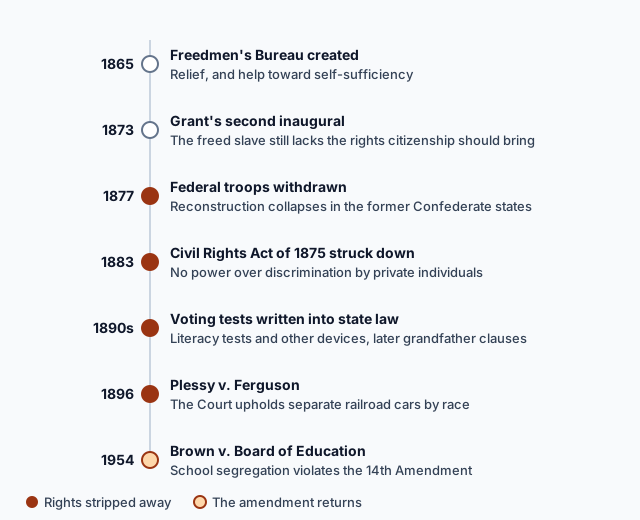 Tap to open the picture full size
Part 1 Think first Freedom, but whose land?
Commit to a guess first. Being wrong now makes the right idea stick better.
Predict first
On March 3, 1865, Congress created the Freedmen's Bureau. Its mission was "to provide relief and help formerly enslaved people become self-sufficient." Freedpeople wanted farms of their own, but the planters who had owned them still owned most of the South's land. How do you think most formerly enslaved families ended up making a living?
In short. Reconstruction failed to secure lasting equality: planters kept most Southern land and sharecropping kept freedpeople and poor whites from owning it, and violence that began during Reconstruction, then segregation laws, voting rules and Supreme Court decisions after federal troops left in 1877, stripped away African American rights, though the 14th and 15th Amendments later grounded the civil rights rulings of the 20th century.
- Formerly enslaved people sought land of their own, but most fell short of self-sufficiency and farmed others' land under an exploitative, soil-wearing sharecropping system.
- As Northern resolve faded, rights were stripped away step by step, during Reconstruction and after it: by Klan terror and intimidation, by literacy tests and grandfather clauses, by Jim Crow segregation, and by rulings such as Plessy v. Ferguson in 1896.
- The amendments stayed in the Constitution, and in 1954 the Supreme Court relied on the 14th to rule school segregation unconstitutional.
Part 2 Learn it How Reconstruction's gains were lost
2a. Freedom without land
Congress set up the Freedmen's Bureau on March 3, 1865. Its agents issued rations and clothing, ran hospitals and refugee camps, and supervised labor contracts between planters and freedpeople. Most of its work was done between June 1865 and December 1868, and it was abolished in 1872.
Self-sufficiency meant land. Formerly enslaved people sought farms of their own, but Southern plantation owners continued to own most of the region's land, during Reconstruction and after it. Without land or money, many freedpeople became sharecroppers: they farmed part of someone else's land and paid the owner with a share of the crop. Many poor white farmers did the same.
The system was exploitative. The landowner kept the land and took his share of every harvest, so a sharecropping family had little left to save toward a farm of its own. It was also soil-intensive: the same land was worked hard, crop after crop, until it wore out. Sharecropping limited both Black and poor white Southerners' access to land, and most freedpeople fell short of the self-sufficiency they had hoped for.
Quick check · Multiple choice
Suppose that in 1870 a formerly enslaved family signs a sharecropping agreement with a planter. Why did arrangements like this keep most freedpeople from becoming self-sufficient?
2b. The North steps back
Protecting rights in the South meant the national government had to keep acting there, year after year. By the 1870s the North's will to do that was fading.
When Grant began his second term in March 1873, he said the freed slave "is not possessed of the civil rights which citizenship should carry with it." In the same speech he claimed the former Confederate states "are now happily rehabilitated," with no special federal control over them, though federal troops still stood in parts of the South. A depression began that September and was still going in 1877.
Rutherford B. Hayes took office in March 1877 after a disputed election, decided by a tribunal set up to count the electoral votes. He granted that "a moral obligation rests upon the National Government" to secure the rights of the people it had emancipated, but he looked to "honest and efficient local self-government as the true resource of those States." That year federal troops were withdrawn from the former Confederate states, Reconstruction collapsed, and the white supremacist wing of the Democratic Party came to dominate the South.
Two ideas of what it meant to be an American citizen had collided. In one, the nation guaranteed your rights wherever you lived. In the other, each state settled its own affairs. After 1877 the second ruled in the South.
Sources: Grant's second inaugural (Avalon Project); Hayes's inaugural (Avalon Project); Black Americans and the Vote (National Archives).
Quick check · Match
Match each phrase from the inaugural addresses of 1873 and 1877 to the idea it expresses.
2c. Rights stripped away
Rights won in the 1860s were stripped away step by step, during Reconstruction and after it. Events after 1877 belong to later periods of the course.
Violence and intimidation began early. The Ku Klux Klan used terror to keep Black men from voting. The Enforcement Acts of 1870 and 1871 suppressed it for a time, until the Supreme Court undermined them. United States v. Cruikshank (1876), a case against Klan members, let Southern states move to suppress Black voting. Local political tactics did the same work: fraud at the polls, and laws such as poll taxes, literacy tests and the "grandfather clause," which let a man vote only if he or his male ancestors could vote before 1867. African Americans still voted and held office in many Southern states through the 1880s. From the early 1890s, former Confederate states wrote these devices into their laws.
Supreme Court decisions narrowed the amendments. In 1883 the Court struck down the Civil Rights Act of 1875, ruling that the 14th Amendment did not give Congress power to stop discrimination by private individuals. In 1896, in Plessy v. Ferguson, the Court upheld an 1890 Louisiana law requiring separate railroad cars for each race, accepting "separate but equal accommodations."
Segregation spread through Jim Crow laws. Separate schools were most common, and segregation soon reached most public places.
Sources: Laws and Court Cases (National Archives); Black Americans and the Vote (National Archives); 15th Amendment (National Archives); Plessy v. Ferguson (National Archives).
Quick check · Sort it
Each card is one way African American rights were stripped away after Reconstruction. Tap a card, then the kind of pressure it was.
A Supreme Court decision
A state or local law or rule
Force and fear
2d. A promise kept for later
The 14th and 15th Amendments stayed in the Constitution while their protections went unenforced, and that mattered later. These cases come from later periods of the course. In Plessy, Justice John Marshall Harlan wrote the lone dissent. He granted that "The white race deems itself to be the dominant race in this country." He then wrote: "But in view of the constitution, in the eye of the law, there is in this country no superior, dominant, ruling class of citizens. There is no caste here. Our constitution is color-blind, and neither knows nor tolerates classes among citizens." Black and white citizens kept petitioning and bringing court cases. The National Archives says their arguments and dissenting opinions "would be the basis for change in the 20th century."
On May 17, 1954, in Brown v. Board of Education, the Supreme Court ruled that segregated public schools violated the 14th Amendment: "Separate educational facilities are inherently unequal." In 1965, at President Lyndon B. Johnson's urging, Congress passed the Voting Rights Act.
Reconstruction left both change and continuity in what it meant to be American. The change was national citizenship and the vote, whatever a person's race, written into the Constitution. The continuity was the power of Southern states and local officials to decide whose rights counted, into the 20th century.
Sources: Plessy v. Ferguson (National Archives); 14th Amendment (National Archives); Brown v. Board of Education (National Archives); 15th Amendment (National Archives).
Quick check · Fill the statement
Complete the notes on how Reconstruction's amendments were later used in court.
In 1896 Justice Harlan wrote a in Plessy v. Ferguson, arguing that the Constitution knows no classes among citizens. In 1954, in Brown v. Board of Education, the Supreme Court ruled that segregated public schools violated the Amendment.
Part 3 Watch it done Compare two presidents on the South
Watch each step, then do the last one yourself.
Grant, second inaugural address, March 4, 1873: "The effects of the late civil strife have been to free the slave and make him a citizen. Yet he is not possessed of the civil rights which citizenship should carry with it. This is wrong, and should be corrected." Hayes, inaugural address, March 5, 1877: "That a moral obligation rests upon the National Government to employ its constitutional power and influence to establish the rights of the people it has emancipated, and to protect them in the enjoyment of those rights when they are infringed or assailed, is also generally admitted." And: "while in duty bound and fully determined to protect the rights of all by every constitutional means at the disposal of my Administration, I am sincerely anxious to use every legitimate influence in favor of honest and efficient local self-government as the true resource of those States for the promotion of the contentment and prosperity of their citizens." Explain the main difference between the two arguments.
Predict first
Before the steps, what do you think divides the two presidents?
Step 1 · State each main idea in your own words
Read each excerpt for two things: what it says about freedpeople's rights, and who it expects to protect them. Write one sentence for each president before you go on.
Why this step?
Why find what the sources share before what divides them?
Two sources that agree on the goal can still split on the means. Naming the shared ground first keeps you from inventing a disagreement that is not there.
Step 2 · Find the shared ground
Look for what both accept. Grant says the freed slave was made a citizen; Hayes speaks of the rights of the people the nation emancipated. Neither one rejects the rights themselves.
Your step · Decide and justify
Finish it. What is the main difference between the two arguments?
Which point best supports your answer?
Part 4 Try it One case, two opinions
This case came almost twenty years after Reconstruction ended, in a later period of the course. In Plessy v. Ferguson, decided May 18, 1896, Justice Henry Brown wrote for the majority, upholding Louisiana's law: "We consider the underlying fallacy of the plaintiff's argument to consist in the assumption that the enforced separation of the two races stamps the colored race with a badge of inferiority. If this be so, it is not by reason of anything found in the act, but solely because the colored race chooses to put that construction upon it."
Justice John Marshall Harlan dissented: "There is no caste here. Our constitution is color-blind, and neither knows nor tolerates classes among citizens."
Try it · Multiple choice
What is the main difference between the two opinions?
Try it · Spot the error
A student compares the two opinions. Which line is the first to go wrong?
Part 5 Explain it Write it like a document-based answer
Nothing you type leaves this page. Check your answer against the model and each scoring point.
Free-response practice · Question 1 style
A short practice in the shape of the document-based question: three documents instead of seven, and a thesis with one body paragraph instead of a full essay.
Evaluate the extent to which the federal government's protection of African Americans' rights changed from the last years of Reconstruction to 1896. (Documents 1 and 2 come from Reconstruction; Document 3 comes from the period after it.)
Document 1. Ulysses S. Grant, second inaugural address, March 4, 1873: "The effects of the late civil strife have been to free the slave and make him a citizen. Yet he is not possessed of the civil rights which citizenship should carry with it. This is wrong, and should be corrected." And: "The States lately at war with the General Government are now happily rehabilitated, and no Executive control is exercised in any one of them that would not be exercised in any other State under like circumstances."
Document 2. Rutherford B. Hayes, inaugural address, March 5, 1877: "while in duty bound and fully determined to protect the rights of all by every constitutional means at the disposal of my Administration, I am sincerely anxious to use every legitimate influence in favor of honest and efficient local self-government as the true resource of those States for the promotion of the contentment and prosperity of their citizens."
Document 3. Plessy v. Ferguson, majority opinion by Justice Henry Brown, 1896: "We consider the underlying fallacy of the plaintiff's argument to consist in the assumption that the enforced separation of the two races stamps the colored race with a badge of inferiority. If this be so, it is not by reason of anything found in the act, but solely because the colored race chooses to put that construction upon it."
Write a thesis, one sentence of historical context, and one paragraph that uses at least two documents and explains the purpose, audience, point of view or situation of one of them.
Model answer
Thesis: From 1873 to 1896 federal protection of African Americans' rights fell a long way, from a president who called their missing rights a wrong to a Supreme Court that upheld segregation, though even in 1873 the national government was already stepping back from the South.
Context: after the Civil War the 14th and 15th Amendments had made African Americans citizens and barred denying the vote by race, and Black men voted and held office across the South.
In 1873 Grant admitted that the freed slave "is not possessed of the civil rights which citizenship should carry with it" and called this wrong (Document 1), yet in the same speech he said the former Confederate states were "happily rehabilitated," with no special federal control. By 1877 Hayes still promised to protect "the rights of all," but he looked to "local self-government as the true resource of those States" (Document 2). Hayes spoke at his inauguration, after a disputed election settled by a special tribunal, to the whole country including white Southerners, so his purpose was to promise both peace and protection, and his words show the national government handing the South back to its own governments; federal troops left that year. By 1896 the Supreme Court said separation stamps no "badge of inferiority" unless Black Americans choose to see one (Document 3), a ruling that let a state separate its citizens by race. Federal protection did not vanish at once; it was given up in stages.
Score your own answer. This is a self-check, not a grade. Tick each point your answer makes.
Part 6 Check yourself One amendment, three moments
The case questions use the three excerpts. The others mix the ideas from the whole lesson.
The excerpts span nearly a century. Sources: 14th Amendment (National Archives); Brown v. Board of Education (National Archives); 15th Amendment (National Archives).
| Document | Excerpt |
|---|---|
| 14th Amendment, first section, ratified 1868. No state shall: | "deny to any person within its jurisdiction the equal protection of the laws" |
| Brown v. Board of Education, Supreme Court, 1954 | "Separate educational facilities are inherently unequal." |
| President Lyndon B. Johnson, asking Congress for a law, March 1965 | "which will make it impossible to thwart the 15th Amendment" |
Case question 1 · Multiple choice
What do the 1954 and 1965 excerpts have in common?
Case question 2 · Multiple choice
Which best explains why nearly a century passed between the 1868 excerpt and the other two?
The rest stand on their own and do not use the case.
Check yourself · Put it in order
Put these events in the order they happened, earliest first.
Check yourself · Select all
Which two statements describe sharecropping in the South after the Civil War? Select two.
Select 2 answers, then check.
Part 7 Keep it Bring back earlier ideas
This lesson stands on Lincoln's wartime leadership from Topic 5.9 and the Reconstruction amendments from Topic 5.10.
Bring it back · Multiple choice
On November 19, 1863, at Gettysburg, Lincoln called for "a new birth of freedom." How did Lincoln use speeches such as this one during the war?
Bring it back · Fill the statement
Complete the notes on the three Reconstruction amendments.
The Amendment abolished slavery, except as punishment for a crime. The Amendment made citizens of all persons born or naturalized in the United States and promised equal protection of the laws. The Amendment barred denying the vote on account of race.
In three lines
- Planters kept most Southern land, and sharecropping left most freedpeople and many poor whites without land or self-sufficiency.
- As the North stepped back, ending with the withdrawal of federal troops in 1877, violence, local voting rules, Jim Crow segregation and Supreme Court rulings stripped away Black rights.
- The 14th and 15th Amendments stayed in the Constitution and became the basis for 20th-century civil rights decisions such as Brown in 1954.
Exam strategy for this topic
- Section I Part A, Multiple Choice: 55 questions in 55 minutes.
- Section I Part B, Short Answer: 3 questions in 40 minutes.
- Section II, Document-Based Question and Long Essay: 2 questions in 100 minutes.
- This lesson's Explain it is shaped like free-response question 1, Document-based.
When you compare two sources, say what they share before what divides them, then quote one phrase from each that shows the difference.
Questions students ask
Did African Americans lose the vote as soon as Reconstruction ended?
No. African Americans voted and held office in many Southern states through the 1880s. Beginning in the early 1890s former Confederate states wrote literacy tests and other devices, among them grandfather clauses, into their laws, and poll taxes, intimidation and fraud did the rest.
Why did federal troops leave the South in 1877?
By then Northern resolve to keep enforcing Reconstruction had faded. Rutherford B. Hayes took office after a disputed election and said he would look to local self-government in the Southern states, and the troops were withdrawn that year.
Was Plessy v. Ferguson ever overturned?
For public schools, yes. In 1954 Brown v. Board of Education held that separate educational facilities are inherently unequal and violate the 14th Amendment, and later federal civil rights laws ended legal segregation in other places.
What did the Freedmen's Bureau do?
It issued rations and clothing, ran hospitals and refugee camps, and supervised labor contracts between planters and freedpeople. Most of its work was done between June 1865 and December 1868, and it was abolished in 1872.
Where can I read these documents in full?
Each excerpt links to its full text at the National Archives or the Avalon Project at Yale Law School, the primary-source collections this lesson was checked against.
Course alignment, for teachers
AP U.S. History topic 5.11, Unit 5: Period 5: 1844–1877.
- Skill 3.C: Compare the arguments or main ideas of two sources.
This lesson maps all 2 essential knowledge statements of the topic, and the one learning objective with none of its own, to the part that teaches each one: 3 are checked by a scored question. The map is in the lesson file.