Unit 3 · Topic 3.8 · about 30 minutes · 7 parts · 13 scored checks, 5 of them multiple choice
AP U.S. History 3.8: The Constitutional Convention and Debates over Ratification
Unit 3: 10 to 17% of the multiple-choice section
What you'll be able to do
- Explain the differing ideological positions on the structure and function of the federal government, and identify and describe the claims that delegates, Federalists and Anti-Federalists made about it.
Key vocabulary
| Term | What it means | The exam trap |
|---|---|---|
| Great Compromise | The convention's settlement on representation: seats in the House by population and an equal vote for each state in the Senate. | It settled the fight between large and small states; it is a different bargain from the ones over slavery. |
| Three-fifths clause | The rule in the Constitution for counting enslaved people when dividing House seats and direct taxes among the states. | Read it as a rule about counting population for power, and ask which states the count helped. |
| Federalists | Supporters of ratifying the Constitution in 1787 and 1788. | In this topic the word names supporters of ratification, not the political party that formed later in the 1790s. |
| Anti-Federalists | Opponents of ratifying the Constitution, who feared a central government too powerful for the states and for individual liberty. | Opposing this Constitution is not the same as opposing any union of the states. |
| Bill of Rights | The first ten amendments to the Constitution, ratified in 1791, listing individual rights and limits on the federal government. | It was added after ratification; it was not part of the document the delegates signed in 1787. |
| Claim | The point an author or speaker wants the audience to accept. | A claim is an argument someone could dispute, not just the subject of the source. |
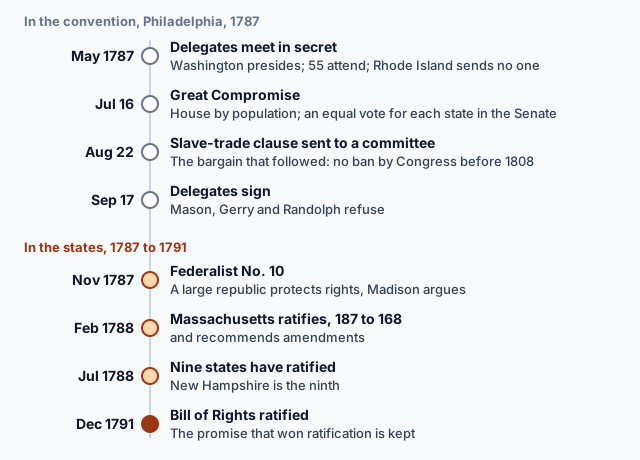 Tap to open the picture full size
Part 1 Think first How do you break a deadlock?
Commit to a guess first. Being wrong now makes the right idea stick better.
Predict first
By early July 1787 the convention in Philadelphia was stuck. Delegates from large states wanted votes in Congress to follow population. Delegates from small states wanted to keep the equal vote each state had under the Articles of Confederation. One delegate thought the convention "was on the verge of dissolution, scarce held together by the strength of an hair." How do you think the deadlock was broken?
In short. At the Constitutional Convention of 1787, delegates from the states bargained their way to a new constitution, including compromises that protected slavery, and in the fight over ratification Federalists won by promising the Anti-Federalists a bill of rights.
- The Great Compromise gave the House seats by population and gave each state two senators.
- The convention counted three-fifths of enslaved people for House seats and barred Congress from ending the international slave trade before 1808, while allowing a ban after it.
- Federalists, whose case Alexander Hamilton and James Madison made in the Federalist Papers, beat the Anti-Federalists by promising the amendments that became the Bill of Rights.
Part 2 Learn it Compromise in Philadelphia, argument in the states
2a. Bargaining over representation
Congress had called delegates to Philadelphia in 1787 to revise the Articles of Confederation. Seventy-four were appointed and 55 attended; Rhode Island sent no one. They chose George Washington to preside, by a unanimous vote, and they met in secret. James Madison of Virginia took notes of the debates day after day, which is why we know what was said. By mid-June the delegates had decided to write an entirely new frame of government instead of amending the Articles.
Edmund Randolph of Virginia opened with the Virginia Plan, a strong national government with votes by population. Randolph admitted it "meant a strong consolidated union in which the idea of states should be nearly annihilated." Delegates from smaller states rallied behind William Paterson of New Jersey, who wanted a "union of the States merely federal." Luther Martin of Maryland insisted: "The States have a right to an equality of representation."
The way out was the Great Compromise. Seats in the House of Representatives would follow population, and each state would have an equal vote in the Senate. Many delegates had come to see that compromise was needed to avoid a complete breakdown of the convention.
Sources: Constitution of the United States: A History (National Archives); Constitution, Milestone Documents (National Archives).
Quick check · Sort it
Each card is a position from the convention's fight over representation. Tap a card, then the side that held it.
Large-state position
Small-state position
2b. Bargains over slavery
Slavery divided the delegates too. More people meant more House seats, so slave states wanted enslaved people counted. The delegates agreed to count three-fifths of them, and to tie direct taxes to the same count. Seats follow numbers "determined by adding to the whole Number of free Persons, including those bound to Service for a Term of Years, and excluding Indians not taxed, three fifths of all other Persons." In that count, "all other persons" meant enslaved people.
Then came the slave trade, bringing enslaved Africans into the country. On August 22, 1787, John Rutledge of South Carolina warned: "If the Convention thinks that N. C. S. C. & Georgia will ever agree to the plan, unless their right to import slaves be untouched, the expectation is vain." George Mason later called the deal "a bargain": New England delegates backed 20 more years of importing enslaved people, and Southern delegates accepted that trade laws would need only a simple majority.
The clause reads: "The Migration or Importation of such Persons as any of the States now existing shall think proper to admit, shall not be prohibited by the Congress prior to the Year one thousand eight hundred and eight." Congress could ban the international slave trade after 1808. Before then, it could not.
Sources: The Constitution (National Archives); Madison's notes, August 22, 1787 (Avalon Project); Constitution: A History (National Archives).
Quick check · Multiple choice
The Constitution says the importation of "such Persons" shall not be prohibited by Congress before 1808. What did this clause do?
2c. Federalists and Anti-Federalists
The delegates signed on September 17, 1787. Elbridge Gerry, Edmund Randolph and George Mason refused. On August 31, inside the convention, Mason had said he "would sooner chop off his right hand than put it to the Constitution as it now stands." Under Article VII, the Constitution would take effect once conventions in nine states ratified it. Federalists supported ratification. Anti-Federalists opposed it.
Anti-Federalists feared a distant central government that would swallow the states and threaten liberty. Writing as Centinel in Philadelphia, Samuel Bryan warned that "The United States are to be melted down" into a despotic empire. In the Virginia convention Patrick Henry mocked the Constitution's checks: "What can avail your specious, imaginary balances, your rope-dancing, chain-rattling, ridiculous ideal checks and contrivances." Both are quoted as the National Archives quotes them.
In New York, Hamilton and John Jay, with help from Madison, began 85 essays now called the Federalist Papers; Hamilton wrote most. Critics said the country was too large for a republic. Madison's No. 10 answered: "Extend the sphere, and you take in a greater variety of parties and interests; you make it less probable that a majority of the whole will have a common motive to invade the rights of other citizens."
A claim is the point an author wants readers to accept. Madison's claim: a large republic protects rights better than a small one.
Sources: Constitution: A History (National Archives), which quotes Mason, Bryan and Henry; Federalist No. 10 (Avalon Project).
Quick check · Match
Match each passage from the fight over the Constitution, 1787 to 1788, to the claim it makes.
2d. The promise of a bill of rights
The Anti-Federalists' strongest weapon was the missing bill of rights. Hamilton argued in Federalist No. 84 that bills of rights "are not only unnecessary in the proposed Constitution, but would even be dangerous." "For why declare that things shall not be done which there is no power to do?"
On February 6, 1788, the Massachusetts convention ratified by 187 votes to 168, and in the same act recommended amendments. It said "certain amendments & alterations in the said Constitution would remove the fears & quiet the apprehensions of many of the good people of this Commonwealth." Its first proposal: "That it be explicitly declared that all Powers not expressly delegated by the aforesaid Constitution are reserved to the several States to be by them exercised." Other states also asked for amendments, and some ratified on the understanding that amendments would be offered. The National Archives concludes that only the promise of amendments ensured the Federalist victory.
Madison kept the promise in the First Congress. Ten amendments were ratified on December 15, 1791, as the Bill of Rights. The Tenth echoes Massachusetts: "The powers not delegated to the United States by the Constitution, nor prohibited by it to the States, are reserved to the States respectively, or to the people."
Sources: Federalist No. 84 (Avalon Project); Massachusetts ratification (Avalon Project); Bill of Rights (National Archives); Bill of Rights transcript (National Archives).
Quick check · Multiple choice
Hamilton called a bill of rights unnecessary, yet the Federalists won ratification by promising one. Which best explains why?
Part 3 Watch it done Find the claim in Madison's notes
Watch each step, then do the last one yourself.
Madison's notes of August 22, 1787, record Edmund Randolph of Virginia during the debate over the slave-trade clause: "By agreeing to the clause, it would revolt the Quakers, the Methodists, and many others in the States having no slaves. On the other hand, two States might be lost to the Union." Identify and describe Randolph's claim.
Predict first
Before the steps, what do you think Randolph wants the convention to do?
Step 1 · Know what kind of source it is
These are Madison's notes, not a transcript. Madison wrote down each speech in his own words, often in the third person, so a speaker's claim reaches us through Madison's summary.
Why this step?
Why does it matter that Madison wrote the words down?
A summary keeps the speaker's argument but not every word. You can describe the claim with confidence, but you should not treat each phrase as the speaker's exact language.
Step 2 · Find what the speaker proposes
Just before the passage, the notes say Randolph wanted the clause committed, that is, sent to a committee to be reworked. The passage then gives his reason.
Your step · Decide and justify
Finish it. Which best describes Randolph's claim?
Which evidence from the notes best supports your answer?
Part 4 Try it Franklin's last speech
On September 17, 1787, the convention's last day, James Wilson read aloud a speech Benjamin Franklin had written. Franklin admitted that there were several parts of the Constitution he did not approve. Then, as Madison's notes record it: "I agree to this Constitution with all its faults, if they are such; because I think a general Government necessary for us." Later: "Thus I consent, Sir, to this Constitution because I expect no better, and because I am not sure, that it is not the best. The opinions I have had of its errors, I sacrifice to the public good." He closed by asking each delegate with objections to doubt a little of his own infallibility and sign.
Source: Madison's notes, September 17, 1787 (Avalon Project).
Try it · Multiple choice
What is Franklin's main claim in the speech?
Try it · Spot the error
A student writes a paragraph on Franklin's speech. Which line is the first to go wrong?
Part 5 Explain it Write it like a document-based answer
Nothing you type leaves this page. Check your answer against the model and each scoring point.
Free-response practice · Question 1 style
A short practice in the shape of the document-based question: three documents instead of seven, and a thesis with one body paragraph instead of a full essay.
Evaluate the extent to which Federalists and Anti-Federalists disagreed about the power of the central government during the ratification debate of 1787 and 1788.
Document 1. The Federalist No. 10, published in the New York Packet, November 23, 1787 (the Avalon Project gives the author as James Madison): "Extend the sphere, and you take in a greater variety of parties and interests; you make it less probable that a majority of the whole will have a common motive to invade the rights of other citizens."
Document 2. The Federalist No. 84 (the Avalon Project gives the author as Alexander Hamilton): "bills of rights, in the sense and to the extent in which they are contended for, are not only unnecessary in the proposed Constitution, but would even be dangerous."
Document 3. Ratification of the Constitution by the Massachusetts convention, February 6, 1788: "That it be explicitly declared that all Powers not expressly delegated by the aforesaid Constitution are reserved to the several States to be by them exercised."
Write a thesis, one sentence of historical context, and one paragraph that uses at least two documents and explains the purpose, audience, point of view or situation of one of them.
Model answer
Thesis: Federalists and Anti-Federalists disagreed sharply about how much power the central government should hold over the states and over individual rights, but the dispute narrowed during ratification, as Federalists accepted amendments that limited federal power in order to win.
Context: under the Articles of Confederation the central government had little power, and unrest such as the farmers' uprising led by Daniel Shays in 1786 convinced many leaders that a stronger government was needed.
Madison argued that a large republic was safe because so many interests would make it hard for any majority to "invade the rights of other citizens" (Document 1). Hamilton went further, claiming a bill of rights was "unnecessary" and even "dangerous" (Document 2). Both essays were written to persuade New York voters to ratify, so they present the Constitution's structure as protection enough and play down Anti-Federalist fears. Yet the Massachusetts convention ratified and, in the same act, asked that all powers "not expressly delegated" be reserved to the states (Document 3), a limit on central power that Anti-Federalists had demanded. The Federalists won, but the Tenth Amendment shows the Anti-Federalist position shaped the final result.
Score your own answer. This is a self-check, not a grade. Tick each point your answer makes.
Part 6 Check yourself A ratifying convention talks back
The case questions use the two excerpts. The others mix the ideas from the whole lesson.
The first excerpt is from the act by which Massachusetts ratified the Constitution. The second is the amendment Congress later proposed and the states ratified. Sources: Massachusetts ratification (Avalon Project); Bill of Rights (National Archives).
| Document | Excerpt |
|---|---|
| Massachusetts ratifying convention, February 6, 1788 | "certain amendments & alterations in the said Constitution would remove the fears & quiet the apprehensions of many of the good people of this Commonwealth" ... First, "That it be explicitly declared that all Powers not expressly delegated by the aforesaid Constitution are reserved to the several States to be by them exercised" |
| Tenth Amendment, ratified December 15, 1791 | "The powers not delegated to the United States by the Constitution, nor prohibited by it to the States, are reserved to the States respectively, or to the people." |
Case question 1 · Multiple choice
What claim does the Massachusetts convention make about its proposed amendments?
Case question 2 · Fill the statement
Complete the notes on the two excerpts.
Massachusetts ratified the Constitution and amendments in the same act. Its first proposal is echoed in the Amendment, which also reserves to the states the powers not delegated.
The rest stand on their own and do not use the case.
Check yourself · Put it in order
Put these events in the order they happened, earliest first.
Check yourself · Select all
Which two parts of the Constitution came out of the convention's compromises over slavery? Select two.
Select 2 answers, then check.
Part 7 Keep it Bring back earlier ideas
This lesson stands on the weakness of the Articles of Confederation from Topic 3.7 and the winning of independence from Topic 3.5.
Bring it back · Fill the statement
Complete the sentences about the government before 1787.
The Articles of Confederation created a central government with power. After the Revolution, troubles over trade, finances, foreign relations and internal unrest led to calls for a central government.
Bring it back · Multiple choice
Britain had apparently overwhelming military and financial advantages in the Revolutionary War. Which was one reason the Patriot cause succeeded anyway?
In three lines
- Delegates in Philadelphia bargained their way to a constitution; the Great Compromise gave the House seats by population and each state two senators.
- The convention compromised over slavery, counting three-fifths of enslaved people and protecting the international slave trade until 1808, after which Congress could ban it.
- Federalists, voiced in the Federalist Papers by Hamilton and Madison, won ratification over the Anti-Federalists by promising the Bill of Rights.
Exam strategy for this topic
- Section I Part A, Multiple Choice: 55 questions in 55 minutes.
- Section I Part B, Short Answer: 3 questions in 40 minutes.
- Section II, Document-Based Question and Long Essay: 2 questions in 100 minutes.
- This lesson's Explain it is shaped like free-response question 1, Document-based.
When a question asks you to identify a claim, state in your own words what the author wants the reader to accept, then point to the words that show it. Naming the topic of a source is not the same as naming its claim.
Questions students ask
Why do Madison's notes describe speakers in the third person?
Madison wrote summaries as the debates happened, not word-for-word transcripts. Most speeches come to us as he recorded them, so treat the wording as his and the argument as the speaker's.
Who wrote the Federalist Papers?
Alexander Hamilton and John Jay, with help from James Madison, wrote the 85 essays, and Hamilton wrote most of them. They first appeared in New York newspapers beginning in late 1787.
Did the Constitution end the slave trade?
No. It barred Congress from banning the international slave trade before 1808. After that year Congress was free to ban it.
Why didn't the delegates put a bill of rights in the Constitution?
Most delegates thought individual rights were secured by the state constitutions, and Federalists such as Hamilton argued the national government had no power to violate them anyway. George Mason disagreed and refused to sign.
Where can I read these documents in full?
Each excerpt links to its full text at the National Archives or the Avalon Project at Yale Law School, the primary-source collections this lesson was checked against.
Course alignment, for teachers
AP U.S. History topic 3.8, Unit 3: Period 3: 1754–1800.
- Skill 3.A: Identify and describe a claim and/or argument in a text-based or non-text-based source.
This lesson maps all 3 essential knowledge statements of the topic, and the one learning objective with none of its own, to the part that teaches each one: 4 are checked by a scored question. The map is in the lesson file.