Unit 6 · Topic 6.7 · about 30 minutes · 7 parts · 13 scored checks, 5 of them multiple choice
AP U.S. History 6.7: Labor in the Gilded Age
Unit 6: 10 to 17% of the multiple-choice section
What you'll be able to do
- Explain the socioeconomic continuities and changes associated with the growth of industrial capitalism from 1865 to 1898, and explain how pieces of evidence about workers' lives in those years support, qualify or contradict one another.
Key vocabulary
| Term | What it means | The exam trap |
|---|---|---|
| Real wages | What a worker's pay can actually buy, given the prices of goods. | Real wages can rise even when the dollar amount of pay stays the same, if prices fall. |
| Standard of living | How well people live, measured by the goods and services they can afford, such as food, clothing and housing. | A rising average standard of living does not mean every person is better off. |
| Labor union | An organization of workers who act together to bargain with employers over wages and working conditions. | Unions can be local or national; a strike is one tactic, not the definition of a union. |
| Child labor | The employment of children for wages, often in factories, mines and mills, at lower pay than adults. | Child labor increased in this period; it did not begin with industry, but industry drew far more children into wage work. |
| Corroborate | To support another piece of evidence by pointing to the same conclusion. | Two sources on the same topic do not corroborate each other unless they support the same claim. |
 Tap to open the picture full size
Part 1 Think first Better off, or worse off?
Commit to a guess first. Being wrong now makes the right idea stick better.
Predict first
On March 4, 1889, President Benjamin Harrison told the nation: "The masses of our people are better fed, clothed, and housed than their fathers were." In 1890, about 1.5 million children under 15 worked in industrial jobs for wages, many because their families needed the pay. How can both be true?
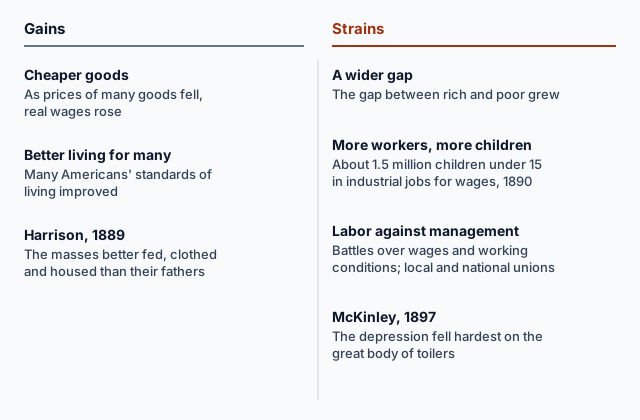
In short. Industrial growth after 1865 brought cheaper goods and better living for many Americans, but it also widened the gap between rich and poor, drew more workers and more children into industry, and set labor against management over wages and working conditions.
- As the price of many goods fell, workers' real wages rose and many Americans' standards of living improved, while the gap between rich and poor grew.
- The industrial workforce expanded, and child labor increased.
- Workers organized local and national unions or confronted business leaders directly in battles over wages and working conditions.
Part 2 Learn it Labor in the Gilded Age
2a. Cheaper goods, better living, a wider gap
Mass production made many goods cheaper. When prices fall, the same pay buys more. Historians call what pay can buy real wages, as opposed to the dollar figure on a pay slip. As the price of many goods dropped, workers' real wages rose, giving them new access to goods and services, and many Americans' standards of living improved.
Harrison claimed exactly that in 1889: "The masses of our people are better fed, clothed, and housed than their fathers were." He did not stop there: "We have not attained an ideal condition. Not all of our people are happy and prosperous; not all of them are virtuous and law-abiding."
While many lived better, the gap between rich and poor grew. Consolidation put control of wealth in few hands: in the Standard Oil Trust, formed in 1882, the profits of all the component companies were sent to nine trustees, who decided the dividends. Wages could also lose value. Arguing for "a sound and stable currency," Grover Cleveland warned in 1893 that "the danger of depreciation in the purchasing power of the wages paid to toil should furnish the strongest incentive to prompt and conservative precaution." Purchasing power is real wages by another name.
Sources: Harrison, 1889 and Cleveland, 1893 (Avalon Project); Sherman Anti-Trust Act summary (National Archives).
Quick check · Sort it
Each card is a piece of evidence about Americans' lives in the Gilded Age. Tap a card, then what it shows.
Living standards improved
Gains were uneven or hardship remained
2b. A bigger workforce, children included
The industrial workforce expanded, and much of the growth came from abroad. Building the first transcontinental railroad in the 1860s, the Union Pacific employed more than 8,000 Irish, German and Italian immigrants, and the Central Pacific's workforce included over 10,000 Chinese laborers.
New workers also met resistance. The Chinese Exclusion Act, approved on May 6, 1882, banned Chinese laborers from immigrating for ten years. It gave its reason in its opening words: "the coming of Chinese laborers to this country endangers the good order of certain localities within the territory thereof."
Child labor increased too. The National Archives explains that the demand for labor grew and many children were drawn into the labor force in the late 1800s. Factory wages were so low that children often had to work to help support their families, and businesses liked to hire children because they worked unskilled jobs for lower wages than adults. In 1890 about 1.5 million children under 15 worked in industrial jobs for wages.
Sources: Pacific Railway Act, Chinese Exclusion Act and Photographs of Lewis Hine, background (National Archives).
Quick check · Multiple choice
Which statement best explains why child labor increased in the late 1800s?
2c. Labor against management
Workers and owners battled over wages and working conditions. Workers organized unions, both local ones in a single workplace or town and national ones that joined workers across the country, and some confronted business leaders directly, for example by striking.
The course framework points to several cases. The Knights of Labor set out the organization's mission in the preamble to its constitution; the framework cites the edition of September 1883. African Americans formed the Colored National Labor Union in 1869 to organize on a national level, because predominantly White organizations denied them membership. The Pullman Strike of 1894 and the violence at Haymarket Square in Chicago became two of the best-known confrontations, and accounts of what happened at Haymarket still differ.
Presidents spoke more generally. In a passage of his 1889 inaugural on obeying the law, aimed at individuals, corporations and communities that set laws aside, Benjamin Harrison named no strike or union. He told corporations: "If our great corporations would more scrupulously observe their legal limitations and duties, they would have less cause to complain of the unlawful limitations of their rights or of violent interference with their operations."
Quick check · Match
Match each action to the kind of response to industrial work it shows.
2d. Reading evidence in pairs
A single source rarely settles a question. Historians ask how two pieces of evidence relate. One can corroborate another, supporting the same claim. One can qualify another, showing where or when it holds and where it does not. One can contradict another, so that both cannot be true as stated.
Set Harrison's 1889 claim that the masses were "better fed, clothed, and housed than their fathers were" beside William McKinley's inaugural address of March 4, 1897: "The depression of the past four years has fallen with especial severity upon the great body of toilers of the country, and upon none more than the holders of small farms." McKinley also described "prevailing business conditions entailing idleness upon willing labor and loss to useful enterprises," that is, people who wanted work and could not find it.
The two do not cancel each other. Harrison spoke before the depression, McKinley after four years of it. Together they show that gains for workers were real but could be wiped out by hard times, which qualifies any claim that industrial growth steadily lifted every worker.
Quick check · Fill the statement
In 1889 President Harrison said the masses were better fed, clothed and housed than their fathers. In 1897 President McKinley said a depression of four years had fallen hardest on the great body of toilers. Complete a student's note on how the two relate.
McKinley's account Harrison's claim. Workers' gains were real, but they rose and fell with .
Part 3 Watch it done Relate two pieces of evidence
Watch each step, then do the last one yourself.
Explain how two pieces of evidence relate. The Chinese Exclusion Act, approved May 6, 1882, opens: "the coming of Chinese laborers to this country endangers the good order of certain localities within the territory thereof." Grover Cleveland's first inaugural address, March 4, 1885, says: "The laws should be rigidly enforced which prohibit the immigration of a servile class to compete with American labor, with no intention of acquiring citizenship, and bringing with them and retaining habits and customs repugnant to our civilization."
Predict first
Before the steps, do you think the two documents agree or disagree about workers from abroad?
Step 1 · State each document's claim
The act bans Chinese laborers for ten years and says their coming endangers good order in some places. Cleveland asks that laws barring a class of workers from immigrating be strictly enforced. He describes those workers as competing with American labor, as having no intention of becoming citizens, and as keeping customs he calls repugnant to American civilization.
Why this step?
Why compare the reasons and not just the conclusions?
Two sources can reach the same conclusion for different reasons. The act points to good order. Cleveland gives his own reasons, and they are not all of one kind. Listing each source's reasons shows whether opposition to immigrant workers rested on one fear or several.
Step 2 · Place them in time
Cleveland spoke less than three years after the act, while its ban was in force. He names no group, but the charges he makes, workers who would not become citizens and kept foreign customs, were the language used against Chinese immigrants in these years.
Your step · Decide and justify
Finish it. How does Cleveland's 1885 statement relate to the 1882 act?
Which evidence best supports your answer?
Part 4 Try it A president on corporations and order
Reread Harrison's words from his inaugural address of March 4, 1889: "If our great corporations would more scrupulously observe their legal limitations and duties, they would have less cause to complain of the unlawful limitations of their rights or of violent interference with their operations."
Try it · Multiple choice
Which reading of Harrison's sentence is best supported by its words?
Try it · Spot the error
A student writes a paragraph on Harrison's sentence about corporations. Which line is the first to go wrong?
Part 5 Explain it Write it like a document-based answer
Nothing you type leaves this page. Check your answer against the model and each scoring point.
Free-response practice · Question 1 style
A short practice in the shape of the document-based question: three documents instead of seven, and a thesis with one body paragraph instead of a full essay.
Evaluate the extent to which industrial growth improved the lives of American workers from 1889 to 1897.
Document 1. Benjamin Harrison, inaugural address, March 4, 1889: "The masses of our people are better fed, clothed, and housed than their fathers were." And: "We have not attained an ideal condition. Not all of our people are happy and prosperous; not all of them are virtuous and law-abiding."
Document 2. Grover Cleveland, second inaugural address, March 4, 1893: "the danger of depreciation in the purchasing power of the wages paid to toil should furnish the strongest incentive to prompt and conservative precaution"
Document 3. William McKinley, first inaugural address, March 4, 1897: "The depression of the past four years has fallen with especial severity upon the great body of toilers of the country, and upon none more than the holders of small farms."
Write a thesis, one sentence of historical context, and one paragraph that uses at least two documents and explains the purpose, audience, point of view or situation of one of them.
Model answer
Thesis: Industrial growth improved many workers' lives to a real but limited extent from 1889 to 1897, raising living standards in good years while leaving workers exposed to hard times that left willing labor idle, and while the gap between rich and poor grew.
Context: after the Civil War, consolidation into trusts such as Standard Oil sent profits to a few men, and the industrial workforce expanded, child labor included, as labor and management battled over wages and working conditions.
In 1889 Harrison claimed the masses were "better fed, clothed, and housed than their fathers were" (Document 1), which fits the rise in real wages as the price of many goods fell. Yet he admitted that "Not all of our people are happy and prosperous," and by 1893 Cleveland, arguing for a sound currency, feared for "the purchasing power of the wages paid to toil" (Document 2), a warning about the value of money more than a report on how workers lived. By 1897 McKinley said the depression had fallen hardest on "the great body of toilers" (Document 3). McKinley spoke for the party now restored to power after Cleveland's term, so he had reason to stress how hard those years had been; even so, his account qualifies Harrison's rather than erasing it, showing that workers' gains rose and fell with business conditions.
Score your own answer. This is a self-check, not a grade. Tick each point your answer makes.
Part 6 Check yourself One president on wages, eight years apart
The case questions use the two excerpts. The others mix the ideas from the whole lesson.
Grover Cleveland served two terms that were not back to back, so he gave two inaugural addresses. In both he was arguing for sound government finances; in 1893 the sentence follows his call for "a sound and stable currency." Sources: Cleveland, 1885; Cleveland, 1893 (Avalon Project).
| Document | Excerpt |
|---|---|
| First inaugural address, March 4, 1885 | Sound public finances should "make the wage of labor sure and steady" |
| Second inaugural address, March 4, 1893 | "the danger of depreciation in the purchasing power of the wages paid to toil should furnish the strongest incentive to prompt and conservative precaution" |
Case question 1 · Multiple choice
Which economic idea is Cleveland's 1893 warning about?
Case question 2 · Multiple choice
How does the 1893 excerpt relate to the 1885 excerpt?
The rest stand on their own and do not use the case.
Check yourself · Select all
Which two are examples of workers organizing or confronting business leaders in the Gilded Age? Select two.
Select 2 answers, then check.
Check yourself · Put it in order
Put these events in the order they happened, earliest first.
Part 7 Keep it Bring back earlier ideas
This lesson stands on the trusts and consolidation of Topic 6.6 and the technological innovation of Topic 6.5.
Bring it back · Multiple choice
In the late 1800s, the stockholders of several oil companies hand their shares to one board, which then runs all the companies. Which development does this illustrate?
Bring it back · Sort it
Each card is something a business in the late 1800s used to produce more goods. Tap a card, then what it draws on.
A technological innovation
Greater access to natural resources
In three lines
- Falling prices raised real wages and many Americans' living standards, while the gap between rich and poor grew.
- The industrial workforce expanded, much of it from abroad, and child labor increased.
- Workers formed local and national unions and confronted business leaders over wages and working conditions.
Exam strategy for this topic
- Section I Part A, Multiple Choice: 55 questions in 55 minutes.
- Section I Part B, Short Answer: 3 questions in 40 minutes.
- Section II, Document-Based Question and Long Essay: 2 questions in 100 minutes.
- This lesson's Explain it is shaped like free-response question 1, Document-based.
When a question asks how two pieces of evidence relate, name the relationship (corroborate, qualify or contradict) and point to the words in each that show it.
Questions students ask
If wages rose, why was there so much labor conflict?
Real wages rose as prices fell, but workers and managers still fought over how much pay and what conditions, and depressions could wipe out gains. In 1897 McKinley described a depression that had fallen hardest on the toilers.
What is the difference between a local and a national union?
A local union joins workers in one workplace or town. A national union joins workers across the country, as the Knights of Labor did and as the Colored National Labor Union did for African American workers shut out of White organizations.
Why did businesses hire children?
The National Archives explains that businesses hired children for unskilled jobs at lower wages than adults, and that factory wages were so low that families often needed their children's pay.
Why are there no union documents quoted in this lesson?
This lesson quotes only primary sources it could check word for word against the National Archives and the Avalon Project at Yale Law School. Neither collection holds the union documents named here, so they are described rather than quoted.
Where can I read these documents in full?
Each excerpt links to its full text at the National Archives or the Avalon Project at Yale Law School, the primary-source collections this lesson was checked against.
Course alignment, for teachers
AP U.S. History topic 6.7, Unit 6: Period 6: 1865–1898.
- Skill 6.C: Use historical reasoning to explain relationships among pieces of historical evidence.
This lesson maps all 3 essential knowledge statements of the topic, and the one learning objective with none of its own, to the part that teaches each one: 4 are checked by a scored question. The map is in the lesson file.