Unit 2 · Topic 2.3 · about 30 minutes · 7 parts · 13 scored checks, 5 of them multiple choice
AP U.S. History 2.3: The Regions of British Colonies
Unit 2: 6 to 8% of the multiple-choice section
What you'll be able to do
- Explain how and why environmental and other factors shaped the development and expansion of various British colonies from 1607 to 1754, and identify and describe the claims colonial founding documents make.
Key vocabulary
| Term | What it means | The exam trap |
|---|---|---|
| Cash crop | A crop grown to sell, often for export, rather than to feed the farmer's own household. | The term names why a crop is grown, not which crop it is, so read what the source says about selling. |
| Indentured servant | A worker who agreed to serve a master for a set number of years, after which the servant went free. | A source about colonial field labor may mean servants or enslaved people; check its date and wording before deciding. |
| Plantation economy | An economy built on large farms that grow cash crops for export with a large unfree labor force. | Plantation describes the scale and the labor system of a farm, not the name of one region. |
| Mixed economy | An economy that combines farming with commerce, such as shipping and trade. | Mixed means more than one kind of work, not a mix of free and enslaved workers. |
| Self-governing institution | A body, such as a town meeting or an elected assembly, through which colonists made their own rules. | An institution can be elected and still be run by a few; ask who could vote and who could serve. |
| Claim | A statement a source wants its reader to accept, which the rest of the source supports. | A claim is what the author argues, not every fact the document happens to mention. |
 Tap to open the picture full size
Part 1 Think first Sugar islands and farm towns
Commit to a guess first. Being wrong now makes the right idea stick better.
Predict first
In a pamphlet printed in London in 1668, the English writer Josiah Child mentioned the price paid for "Barbados Sugars in London." Barbados is an island in the British West Indies. In the same years, most New England families farmed small plots near their towns. Both places were British colonies. What do you think did most to make them so different?
In short. England's mainland colonies and West Indies islands grew into distinct regions because their climates and soils suited different crops and labor systems, and because their founders came with different religious and political aims.
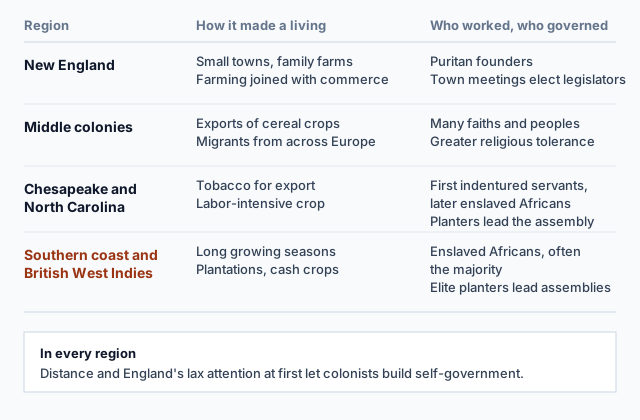
- The Chesapeake and North Carolina exported tobacco, grown first by mostly male white indentured servants and later by enslaved Africans; the southern Atlantic coast and the West Indies built plantation economies on cash crops and enslaved labor.
- New England, settled by Puritans, grew around small towns and family farms with a mixed economy of farming and commerce; the middle colonies exported cereal crops and drew migrants from across Europe, which made them more diverse and more tolerant.
- Distance and England's lax attention at first let colonists build self-government unusually democratic for its time, through town meetings in New England and through assemblies dominated by elite planters in the South.
Part 2 Learn it Four regions of British colonies
2a. The Chesapeake: tobacco and the labor it took
The Chesapeake colonies, Virginia and Maryland on Chesapeake Bay, and North Carolina to their south, grew prosperous by exporting tobacco. Tobacco was a cash crop, grown to sell rather than to feed a household, and buyers in Europe wanted it.
Tobacco is labor-intensive. A planter needed many hands to plant, tend and harvest it. More land planted meant more workers needed.
At first most of that work was done by indentured servants: white workers, mostly men, who agreed to serve a master for a set number of years. Later, planters came to rely on enslaved Africans instead. An indentured servant's term ended; enslaved Africans had no term to serve out.
The environment made tobacco possible, and the demand for tobacco shaped who lived and worked in the region.
Quick check · Fill the statement
Complete the notes on the Chesapeake's labor force.
Tobacco needed many workers. At first most of them were , who served for a set number of years. Later, planters relied more and more on .
2b. New England and the middle colonies
New England was settled at first by Puritans, who came to build communities around their faith. When three Connecticut towns joined under one government in 1639, they said they did so "to maintain and preserve the liberty and purity of the Gospel of our Lord Jesus which we now profess." New Englanders lived in small towns with family farms, and the region built a thriving mixed economy, farming joined with commerce.
The middle colonies, Pennsylvania among them, supported a flourishing export economy based on cereal crops, grains grown for sale. They drew a broad range of European migrants, and the mix led to societies with greater cultural, ethnic and religious diversity and tolerance. Pennsylvania's laws of 1682 put that tolerance in writing:
Quick check · Sort it
Tap a card, then the region it describes.
New England
Middle colonies
2c. Plantations of the southern coast and the West Indies
Farther south, the colonies of the southern Atlantic coast, such as Carolina, and England's West Indies islands, such as Barbados, had long growing seasons. Planters used them to build plantation economies: large farms that grew cash crops for export.
Those plantations depended on the labor of enslaved Africans, who often made up the majority of the population in these places. Carolina's proprietors, the lords who held the colony's grant, planned for such a colony. Their Fundamental Constitutions of 1669 were a plan of government, not a record of how the colony actually ran. One article reads:
The plan uses "negro," the word of its time for a person of African descent; it is quoted as printed because its wording is the evidence. The last words mean that an enslaved person's religion, even becoming a Christian, would not limit the master's power. As a plan, it shows what the proprietors intended: a colony in which slavery was expected from the start.
Enslaved Africans were not only laborers. Where they made up most of the population, they developed their own forms of cultural and religious autonomy: ways of living, worshiping and keeping traditions that they shaped themselves.
Quick check · Multiple choice
Which best explains why enslaved Africans often made up most of the population in the British West Indies?
2d. Self-government, by towns and by planters
England was far away, and at first it paid its colonies little close attention. Distance and that lax attention let self-governing institutions grow that were unusually democratic for the era. Some were set up from above: the Virginia Company created Virginia's assembly, and Carolina's proprietors wrote their plan. Connecticut's towns wrote their Fundamental Orders themselves. Either way, colonists used these bodies to govern themselves.
In New England, power rested in participatory town meetings, which in turn elected members to the colonial legislature. The Fundamental Orders of 1639 said that "Windsor, Hartford, and Wethersfield shall have power, each Town, to send four of their Freemen as their deputies to every General Court," the colony's lawmaking body.
In the southern colonies, elite planters held local authority and also dominated the elected assemblies. Carolina's proprietors planned for rule by large landholders, not by numbers. They wrote their plan for "establishing the interest of the lords proprietors with equality and without confusion," and so "that we may avoid erecting a numerous democracy."
Sources: Fundamental Orders of 1639 (Avalon Project); Fundamental Constitutions of Carolina (Avalon Project).
Quick check · Match
Match each piece of evidence to what it shows about colonial self-government.
Part 3 Watch it done Find the claim in William Penn's Frame of Government
Watch each step, then do the last one yourself.
In the preface to his Frame of Government of Pennsylvania (May 5, 1682), William Penn wrote: "Any government is free to the people under it (whatever be the frame) where the laws rule, and the people are a party to those laws, and more than this is tyranny, oligarchy, or confusion." Identify and describe Penn's claim about what makes a government free.
Predict first
Before the steps, what do you think Penn says makes a government free?
Step 1 · Name the author and the purpose
Penn had been granted Pennsylvania by the king, and the Frame of Government was his plan for its government. A founder introducing his plan has a reason to argue that it makes people free.
Why this step?
Why find the purpose before the claim?
A claim is what the author wants the reader to accept. Knowing what the author is trying to do tells you which sentence carries the argument and which only supports it.
Step 2 · Split the sentence into its parts
The main clause says a government is free "where the laws rule, and the people are a party to those laws." The words in parentheses qualify that claim. The last part names what falls short: tyranny, oligarchy, confusion.
Your step · Decide and justify
Finish it. Which description of Penn's claim is accurate?
Which words from the passage best support your answer?
Part 4 Try it Self-government in the Chesapeake
On July 24, 1621, the Virginia Company in England issued an ordinance for its Chesapeake colony. It set up a General Assembly made up of the colony's Council of State and "two Burgesses out of every Town, Hundred, or other particular Plantation, to be respectively chosen by the Inhabitants." The Avalon Project's note on the document adds: "The first Assembly of Virginia was convened July 3-Aug. 9, 1619, at Jamestown".
Eighteen years later, Connecticut's Fundamental Orders of 1639 said that "Windsor, Hartford, and Wethersfield shall have power, each Town, to send four of their Freemen as their deputies to every General Court."
Sources: Ordinances for Virginia, 1621 (Avalon Project); Fundamental Orders of 1639 (Avalon Project).
Try it · Multiple choice
What claim does the 1621 ordinance make about how Virginia's laws would be made?
Try it · Spot the error
A student compares Virginia's 1621 ordinance with Connecticut's 1639 Fundamental Orders. Which line is the first to go wrong?
Part 5 Explain it Write it like a document-based answer
Nothing you type leaves this page. Check your answer against the model and each scoring point.
Free-response practice · Question 1 style
A short practice in the shape of the document-based question: three documents instead of seven, and a thesis with one body paragraph instead of a full essay.
Evaluate the extent to which the environment explains the differences among England's colonial regions between 1607 and 1754.
Document 1. Fundamental Orders of Connecticut, 1639, agreed by the towns of Windsor, Hartford and Wethersfield: they join together "to maintain and preserve the liberty and purity of the Gospel of our Lord Jesus which we now profess." And: "which deputies shall have the power of the whole Town to give their votes and allowance to all such laws and orders as may be for the public good."
Document 2. Fundamental Constitutions of Carolina, 1669, a plan of government written by the colony's lords proprietors: they wrote it for "establishing the interest of the lords proprietors with equality and without confusion," and so "that we may avoid erecting a numerous democracy."
Document 3. Josiah Child, a pamphlet on trade printed in London, 1668: "the Sugar-Bakers of Holland can afford to give a greater prize for Barbados Sugars in London" (spelling as printed; sugar-bakers were sugar refiners, and prize means price).
Write a thesis, one sentence of historical context, and one paragraph that uses at least two documents and explains the purpose, audience, point of view or situation of one of them.
Model answer
Thesis: The environment explains the regions' economies to a large extent, since long growing seasons made plantations for export possible in the south and the West Indies, but the religious and political aims of each region's founders explain their governments and societies just as much.
Context: English colonization drew comparatively large numbers of migrants seeking prosperity, social mobility and religious freedom, and England's distance and lax attention at first left them room to set up their own institutions.
Child's remark that Dutch refiners paid well for "Barbados Sugars in London" (Document 3) shows a West Indies island exporting a cash crop, the plantation economy long growing seasons made possible, so there the environment counts for a great deal. Carolina's Fundamental Constitutions (Document 2), by contrast, were a plan, written by the lords proprietors to secure "the interest of the lords proprietors"; as a plan, they show what the proprietors intended, not how the colony worked, and their aim to "avoid erecting a numerous democracy" was a political choice, not a fact of climate. Connecticut's towns joined to preserve "the liberty and purity of the Gospel" (Document 1) and gave town deputies the power to vote on laws, a Puritan design for self-government. Climate shaped how colonists made a living; founders' aims shaped how they lived together and governed.
Score your own answer. This is a self-check, not a grade. Tick each point your answer makes.
Part 6 Check yourself Two plans of colonial government
The case questions use the two excerpts. The others mix the ideas from the whole lesson.
Both excerpts are from founding plans of government, one from New England and one from the southern Atlantic coast. Sources: Fundamental Orders of 1639 (Avalon Project); Fundamental Constitutions of Carolina (Avalon Project).
| Document | Excerpt |
|---|---|
| Fundamental Orders of Connecticut, 1639 | "Windsor, Hartford, and Wethersfield shall have power, each Town, to send four of their Freemen as their deputies to every General Court" |
| Fundamental Constitutions of Carolina, 1669 | "No man shall be chosen a member of parliament who has less than five hundred acres of freehold within the precinct for which he is chosen; nor shall any have a vote in choosing the said member that hath less than fifty acres of freehold within the said precinct." |
Case question 1 · Multiple choice
What does the Carolina excerpt claim about who should make the colony's laws?
Case question 2 · Multiple choice
Which best explains the difference between the two excerpts?
The rest stand on their own and do not use the case.
Check yourself · Select all
Which two developments describe the middle colonies? Select two.
Select 2 answers, then check.
Check yourself · Fill the statement
Complete the description of the West Indies and the southern Atlantic coast.
Long let planters grow for export. Enslaved Africans, often the of the population, developed their own forms of cultural and religious autonomy.
Part 7 Keep it Bring back earlier ideas
This lesson stands on the different European colonizers from Topic 2.2 and the competition among them from Topic 2.1.
Bring it back · Multiple choice
A colonizing power sends relatively few Europeans to North America. Its traders build alliances with American Indians, some marry into Native communities, and it ships furs back to Europe. Which colonizers does this describe?
Bring it back · Match
Suppose French and English traders both want the furs that a Native nation's hunters bring in. Match each part of the story to what it shows about competition over resources.
In three lines
- Tobacco made the Chesapeake prosperous, worked first by indentured servants and later by enslaved Africans; long growing seasons gave the southern coast and West Indies plantations worked by enslaved majorities.
- Puritan New England grew around towns, family farms and mixed commerce; the middle colonies exported cereal crops and drew diverse European migrants, with more tolerance.
- Distance and England's lax attention at first let colonists govern themselves, through town meetings in New England and planter-led assemblies in the South.
Exam strategy for this topic
- Section I Part A, Multiple Choice: 55 questions in 55 minutes.
- Section I Part B, Short Answer: 3 questions in 40 minutes.
- Section II, Document-Based Question and Long Essay: 2 questions in 100 minutes.
- This lesson's Explain it is shaped like free-response question 1, Document-based.
When a question asks for a source's claim, find the sentence the rest of the passage supports, put it in your own words, and quote the few words that prove you read it right.
Questions students ask
Which colonies were in each region?
This lesson uses the regions as College Board's course framework does: New England, the middle colonies, the Chesapeake with North Carolina, and the colonies of the southern Atlantic coast with the British West Indies. Its examples are Connecticut, Pennsylvania, Virginia and Maryland, Carolina and Barbados.
Was slavery only a southern institution?
No. All the British colonies took part to varying degrees in the Atlantic slave trade. Small New England farms used relatively few enslaved laborers, port cities held significant minorities of enslaved people, and the plantation systems of the Chesapeake and the southern Atlantic coast had large numbers, while the great majority of enslaved Africans were sent to the West Indies. Topic 2.6, Slavery in the British Colonies, looks at this in full.
Why does the lesson quote a plan that uses an old racial term?
The Carolina plan is quoted exactly as the archive prints it because its wording is the evidence: it shows the proprietors planning a colony in which masters held absolute power over enslaved people. The word was the term of its time for a person of African descent.
Were colonial governments democracies?
They were unusually democratic for their era, since colonists elected assemblies and New England towns chose deputies. But voting and office were limited, and in the South elite planters dominated the assemblies.
Why does the lesson say England rather than Britain?
Most documents in this lesson come from the 1600s, when they speak of the kingdom of England. The course framework calls the empire British throughout the period, which runs to 1754.
Where can I read these documents in full?
Each excerpt links to its full text at the Avalon Project at Yale Law School, the primary-source collection this lesson was checked against.
Course alignment, for teachers
AP U.S. History topic 2.3, Unit 2: Period 2: 1607–1754.
- Skill 3.A: Identify and describe a claim and/or argument in a text-based or non-text-based source.
This lesson maps all 5 essential knowledge statements of the topic, and the one learning objective with none of its own, to the part that teaches each one: 6 are checked by a scored question. The map is in the lesson file.