Unit 4 · Topic 4.2 · about 30 minutes · 7 parts · 11 scored checks, 4 of them multiple choice, plus 2 from earlier lessons
AP U.S. History 4.2: The Rise of Political Parties and the Era of Jefferson
Unit 4: 10 to 17% of the multiple-choice section
What you'll be able to do
- Explain the causes and effects of policy debates in the early republic, and identify the point of view, purpose, historical situation and audience of the documents that record them.
Key vocabulary
| Term | What it means | The exam trap |
|---|---|---|
| Democratic-Republicans | The party that formed in the 1790s around Thomas Jefferson and James Madison. | The name is not the same as either modern party; read it as the party of its own time. |
| Judicial review | The courts' power to rule on whether a law is constitutional. | It is a power the courts claimed in a decision; do not say the Constitution's text grants it. |
| Embargo | A law that keeps a country's own ships from trading with foreign ports; the Embargo Act of 1807 restricted American foreign trade. | An embargo limits a country's own ships and trade; it is not a tax on imports. |
| Louisiana Purchase | The 1803 treaty by which the United States bought from France the land west of the Mississippi River called Louisiana. | The purchase covered far more than the present state of Louisiana. |
| Point of view | The position an author writes from, which shapes what he says. | Find it in the author's own situation, not in your view of the subject. |
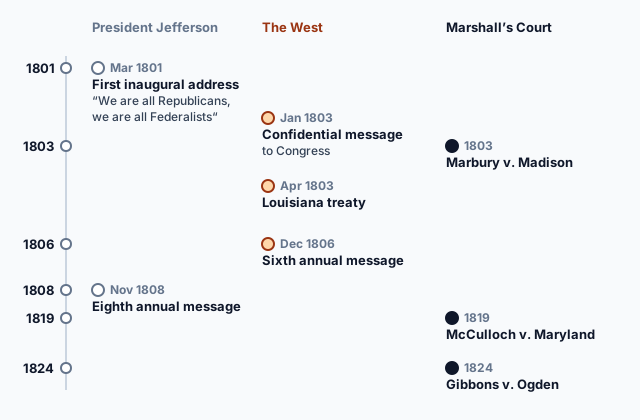 Tap to open the picture full size
Part 1 Think first Republicans and Federalists
Commit to a guess first. Being wrong now makes the right idea stick better.
Predict first
On March 4, 1801, Thomas Jefferson, a leader of the Democratic-Republicans, gave his first inaugural address. He spoke of "the contest of opinion through which we have passed" and then said: "We are all Republicans, we are all Federalists." Why do you think the new president said this?
In short. After Thomas Jefferson took office in 1801, the parties kept arguing over the tariff, federal power and Europe; John Marshall's Supreme Court claimed the final word on the Constitution and put federal law over state law; and the government explored and sought control of the land the Louisiana Purchase added.
- Jefferson's inaugural promised support for the states and "a wise and frugal Government," but the embargo and the purchase of Louisiana raised hard questions about how far federal power reached, and Federalists in the seaports opposed his party's trade policies.
- In Marbury v. Madison (1803) the Court for the first time declared a law of Congress unconstitutional, and in McCulloch v. Maryland (1819) and Gibbons v. Ogden (1824) it ruled federal law ahead of state law.
- After buying Louisiana in 1803, the government sent Lewis and Clark and other explorers into the West and sought relations and trade with its American Indian nations.
Part 2 Learn it Policy debates in the era of Jefferson
2a. The same arguments, a new party in power
In the 1790s, arguments over the national government and the states, economic policy and foreign policy had produced two parties. The Federalists, led by Alexander Hamilton and John Adams, supported a strong government with federal institutions playing a leading role. The Democratic-Republicans, led by Thomas Jefferson and James Madison, favored a weaker, less active federal government that left more authority to the states. Jefferson's election did not end those arguments. In the early 1800s the parties kept debating the tariff, the powers of the federal government and relations with European powers.
In his inaugural address Jefferson listed what he called the essential principles of the government. Some are about the balance of power: "the support of the State governments in all their rights" beside "the preservation of the General Government in its whole constitutional vigor." Some are about the world: "peace, commerce, and honest friendship with all nations, entangling alliances with none." Others are about the economy: "a wise and frugal Government" and "encouragement of agriculture, and of commerce as its handmaid."
A list like this is a party leader's program, stated as if everyone already shared it.
Sources: Jefferson's First Inaugural Address (Avalon Project); The Two-Party System (National Archives).
Quick check · Sort it
Each card is a phrase from Jefferson's first inaugural address. Tap a card, then the issue it speaks to.
Federal and state power
Relations with other nations
Government and the economy
2b. The embargo: causes, effects and opposition
Relations with European powers became the hardest test. During the Napoleonic Wars the warring powers interfered with American ships and trade, and a British warship attacked the American frigate Chesapeake. In December 1807 the Embargo Act restricted the nation's foreign trade. (The date and the wartime setting are from the course framework's suggested sources for this topic.)
On November 8, 1808, Jefferson defended the embargo to Congress. He blamed "the belligerent nations, whose disregard of neutral rights has been so destructive to our commerce," and credited the embargo with "saving our mariners and our vast mercantile property." He also reported that "Some small and special detachments have been necessary to maintain the laws of embargo on that portion of our northern frontier which offered peculiar facilities for evasion." And cut off from foreign trade, Americans began "to apply a portion of our industry and capital to internal manufactures and improvements," which Jefferson expected "protecting duties," a tariff, to sustain.
The other party saw it differently. Centered in seaports, the Federalists opposed the War of 1812 because it disrupted trade, and in 1814 their Hartford Convention proposed amendments to the Constitution, among them that "Congress shall not have power to lay any embargo on the ships or vessels of the citizens of the United States, in the ports or harbors thereof, for more than sixty days."
Sources: Jefferson's Eighth Annual Message (Avalon Project); The Two-Party System (National Archives); Hartford Convention amendments (Avalon Project).
Quick check · Sort it
Tap a card, then say whether it was a cause of the embargo or a result of it.
A cause of the embargo
A result of the embargo
2c. The Court and the Constitution
Nothing in the Constitution's text gave the Supreme Court the power to strike down a law. Chief Justice John Marshall's Court claimed it. In 1801, outgoing President John Adams had issued William Marbury a commission as a justice of the peace, and the new Secretary of State, James Madison, refused to deliver it. In Marbury v. Madison (1803) the Court held that the part of the act establishing the federal courts that would have let it order the commission delivered conflicted with the Constitution. For the first time it declared unconstitutional a law passed by Congress and signed by the President. "It is emphatically the province and duty of the judicial department to say what the law is," Marshall wrote, and "a law repugnant to the constitution is void." This is judicial review.
Later decisions put federal law ahead of state law. In 1818 Maryland taxed the Second National Bank, which Congress had established in 1816. In McCulloch v. Maryland (1819) the Court ruled that "the States have no power, by taxation or otherwise, to retard, impede, burden, or in any manner control, the operations of the constitutional laws enacted by Congress." In Gibbons v. Ogden (1824) it held that "Commerce among the states cannot stop at the external boundary line of each state."
Sources: Marbury v. Madison; McCulloch v. Maryland; Gibbons v. Ogden (National Archives).
Quick check · Match
Match each line from Marshall's Court to the principle it states.
2d. Louisiana, and the effort to know and hold it
On April 30, 1803, the United States bought 828,000 square miles west of the Mississippi River from France for $15 million and doubled its size.
The purchase raised a question about federal power. Jefferson was generally a strict interpreter of the Constitution, and he wondered whether the government was authorized to acquire new territory at all. He drafted an amendment that began: "The province of Louisiana is incorporated with the U. S. and made part thereof." When Napoleon threatened to take back the offer, Jefferson set his doubts aside.
The government then sought influence and control over the new land through exploration and diplomacy. Jefferson had asked Congress in January 1803, before the purchase, to fund an expedition west; much of the land it would cross became American in the purchase. Meriwether Lewis and William Clark were instructed to seek new trade routes and to establish relations with the western American Indian nations. Other expeditions followed. In 1806 Jefferson reported: "Very useful additions have also been made to our knowledge of the Mississippi by Lieutenant Pike, who has ascended to its source."
Sources: Louisiana Purchase Treaty (National Archives); Jefferson's draft amendment (Avalon Project); Jefferson's message on exploring the West (National Archives); Sixth Annual Message (Avalon Project).
Quick check · Multiple choice
After the Louisiana Purchase, which approach did the federal government take to extend its influence over the new land?
Part 3 Watch it done Source Jefferson's request to explore the West
Watch each step, then do the last one yourself.
On January 18, 1803, President Jefferson sent Congress a confidential message asking for $2,500 so that "An intelligent officer, with ten or twelve chosen men" could "explore the whole line, even to the Western Ocean." He presented the money as a way of extending the external commerce of the United States. Identify the message's audience and purpose.
Predict first
Before the steps, why do you think Jefferson kept this message confidential?
Step 1 · Place it in time
In January 1803 the land the expedition would cross did not belong to the United States, and the treaty buying Louisiana would not be signed until April 30. Jefferson called the owner "The nation claiming the territory."
Why this step?
Why does the date matter for a question about audience and purpose?
Who held the land decides what is risky to say about it, and to whom. A request to cross another nation's land reads differently from a plan for your own.
Step 2 · Name the audience
The message is addressed to "Gentlemen of the Senate, and of the House of Representatives" and marked confidential. Its first part, on trading houses and the purchase of Indian land, Jefferson "committed to the special confidence of the two Houses." The expedition comes in a later part of the same message. Congress, not the public, was the audience.
Your step · Decide and justify
Finish it. What was the main purpose of presenting the expedition as a matter of commerce?
Which evidence best supports your answer?
Part 4 Try it Read Jefferson's report on the West
Jefferson had asked Congress, in a confidential message of January 18, 1803, to pay for an expedition west, and Congress agreed to fund it. On December 2, 1806, in his Sixth Annual Message to Congress, he reported that Lewis and Clark "have traced the Missouri nearly to its source, descended the Columbia to the Pacific ocean," and had "learned the character of the country, of its commerce, and inhabitants." He added: "it is but justice to say that Messrs. Lewis and Clarke, and their brave companions, have by this arduous service deserved well of their country" (spelling as printed). The same message said that the attempt to explore the Red river "has not been equally successful."
Sources: Jefferson's message on exploring the West (National Archives); Jefferson's Sixth Annual Message (Avalon Project).
Try it · Multiple choice
Which best describes the point of view of this report?
Try it · Spot the error
A student writes a sourcing paragraph on the 1806 report. Which line is the first to go wrong?
Part 5 Explain it Write it like a document-based answer
Nothing you type leaves this page. Check your answer against the model and each scoring point.
Free-response practice · Question 1 style
A short practice in the shape of the document-based question: three documents instead of seven, and a thesis with one body paragraph instead of a full essay.
Evaluate the extent to which Thomas Jefferson's presidency expanded the powers of the federal government.
Document 1. Thomas Jefferson, First Inaugural Address, March 4, 1801. Among the government's essential principles he listed "the support of the State governments in all their rights" and "a wise and frugal Government."
Document 2. Thomas Jefferson, draft of an amendment to the Constitution, 1803: "The province of Louisiana is incorporated with the U. S. and made part thereof." Jefferson, generally a strict interpreter of the Constitution, doubted the government was authorized to acquire new territory; when Napoleon threatened to take back the offer, he set those doubts aside.
Document 3. Thomas Jefferson, Eighth Annual Message to Congress, November 8, 1808: "Some small and special detachments have been necessary to maintain the laws of embargo on that portion of our northern frontier which offered peculiar facilities for evasion."
Write a thesis, two or three sentences of historical context, and one paragraph that uses at least two documents and explains the purpose, audience, point of view or situation of one of them.
Model answer
Thesis: Jefferson took office promising a limited government that respected the states, but buying Louisiana and enforcing the embargo greatly expanded what the federal government did, even as he kept treating the Constitution's limits as real.
Context: in the 1790s, Federalists led by Alexander Hamilton and John Adams had backed a strong federal government, while Democratic-Republicans led by Jefferson and James Madison favored a weaker one that left more to the states. When Jefferson's party took power in 1801, the question was whether it would keep the federal government as small as it had argued.
In his inaugural address Jefferson promised "the support of the State governments in all their rights" and "a wise and frugal Government" (Document 1). He was speaking after what he called a "contest of opinion" to a divided country, so the address states ideals meant to reassure, not a record of what he would do. Two years later he doubled the nation's size, though his own draft amendment (Document 2) shows he doubted the Constitution allowed it. By 1808 the government was sending detachments to the northern frontier to stop Americans from evading the embargo (Document 3). A president who had promised to leave the states their rights was using federal power to control his own citizens' trade.
Score your own answer. This is a self-check, not a grade. Tick each point your answer makes.
Part 6 Check yourself What the negotiators were sent to buy
The case questions use the table. The others mix ideas from the whole lesson.
The figures come from the National Archives' record of the Louisiana Purchase Treaty; the last row is from Jefferson's draft amendment. Sources: Louisiana Purchase Treaty (National Archives); Jefferson's draft amendment (Avalon Project).
| Stage | What it covered | Price |
|---|---|---|
| What Robert Livingston and James Monroe were authorized to buy | The port of New Orleans and the Floridas only | Up to $10 million |
| What they agreed to when France offered all of Louisiana, signed April 30, 1803 | 828,000 square miles west of the Mississippi River, doubling the nation | $15 million |
| Jefferson's draft amendment to the Constitution, 1803 | "The province of Louisiana is incorporated with the U. S. and made part thereof." | None |
Case question 1 · Multiple choice
What does the table show about how the purchase came about?
Case question 2 · Multiple choice
The table's last row shows Jefferson drafting an amendment. Which debate over federal power did the purchase raise most directly?
The rest stand on their own and do not use the case.
Check yourself · Fill the statement
Complete a historian's notes on the Hartford Convention's proposal to limit any embargo to sixty days.
The proposal came from ; that is its point of view. It was written in 1814, during , which is its historical situation.
Check yourself · Select all
Which two of these put federal law ahead of state law? Select two.
Select 2 answers, then check.
Part 7 Keep it Bring back earlier ideas
This lesson stands on the larger stories of Period 4 from Topic 4.1 and on the ideas behind independence from Topic 3.4.
From 4.1 Contextualizing Period 4 · Sort it
Tap a card, then say whether it helped drive the market revolution or was one of its effects on American life.
Helped drive it
An effect on American life
In 1776 the ideals were stated for "all men" and practiced for far fewer. Virginia limited the vote, and the Declaration itself calls Native Americans "merciless Indian Savages." Yet the words kept their hold on how Americans understood the nation. On November 19, 1863, during the Civil War, Abraham Lincoln spoke where part of the Gettysburg battlefield was being dedicated as "a final resting-place for those who here gave their lives that that nation might live." He began: "Fourscore and seven years ago our fathers brought forth on this continent a new nation, conceived in liberty and dedicated to the proposition that all men are created equal." Fourscore and seven years is 87, which counts back to 1776. He called for "a new birth of freedom" and resolved "that government of the people, by the people, for the people shall not perish from the earth."
Source: Gettysburg Address (Avalon Project). The AP U.S. History course framework names Lincoln as the speaker, in its Period 5 topics.
From 3.4 Philosophical Foundations of the American Revolution · Multiple choice
What does Lincoln's use of the Declaration in 1863 show about continuity and change in the nation's founding ideals?
In three lines
- After 1801 the parties kept debating the tariff, federal power and relations with Europe, and the embargo turned a foreign policy into a fight at home.
- Marshall's Court established judicial review in Marbury v. Madison and put federal law over state law in McCulloch v. Maryland and Gibbons v. Ogden.
- After the Louisiana Purchase, the government used exploration and diplomacy to learn about and extend its reach over the West.
Exam strategy for this topic
- Section I Part A, Multiple Choice: 55 questions in 55 minutes.
- Section I Part B, Short Answer: 3 questions in 40 minutes.
- Section II, Document-Based Question and Long Essay: 2 questions in 100 minutes.
- This lesson's Explain it is shaped like free-response question 1, Document-based.
When a question asks for a document's point of view or purpose, name the author's position or goal and quote the words that show it, then say how it shapes what the document includes.
Questions students ask
Did the Federalists disappear when Jefferson became president?
No. In the early 1800s national parties continued to debate the tariff, the powers of the federal government and relations with European powers. Jefferson's "We are all Republicans, we are all Federalists" was an appeal for calm, not a report that the parties had merged.
Where does the Supreme Court's power of judicial review come from?
Not from the Constitution's words. The National Archives notes that nothing stated in the Constitution gave the Court that specific power; Chief Justice John Marshall established it in Marbury v. Madison in 1803.
Why did Jefferson doubt he could buy Louisiana?
He was generally a strict interpreter of the Constitution and wondered whether it authorized the government to acquire new territory. He drafted an amendment to make Louisiana part of the United States, but when Napoleon threatened to take back the offer, he set his doubts aside.
Why does a quotation in this lesson spell Clark as "Clarke"?
Every excerpt is copied exactly as the archive prints it, so you can check it against the source linked beside it. Jefferson's 1806 message spells the name Clarke.
Where can I read these documents in full?
Each excerpt links to its full text at the National Archives or the Avalon Project at Yale Law School, the primary-source collections this lesson was checked against.
Course alignment, for teachers
AP U.S. History topic 4.2, Unit 4: Period 4: 1800–1848.
- Skill 2.A: Identify a source’s point of view, purpose, historical situation, and/or audience.
This lesson maps all 3 essential knowledge statements of the topic, and the one learning objective with none of its own, to the part that teaches each one: 4 are checked by a scored question. The map is in the lesson file.