Unit 8 · Topic 8.2 · about 30 minutes · 7 parts · 13 scored checks, 4 of them multiple choice
AP U.S. History 8.2: The Cold War from 1945 to 1980
Unit 8: 10 to 17% of the multiple-choice section
What you'll be able to do
- Explain the continuities and changes in Cold War policies from 1945 to 1980, and explain how a Cold War source's purpose, audience and historical situation affect what it can show.
Key vocabulary
| Term | What it means | The exam trap |
|---|---|---|
| Containment | The Cold War goal of stopping communism from spreading to more countries, by aid, alliances and, when leaders judged it necessary, war. | Containment means stopping the spread of communism, not overthrowing the Soviet Union itself. |
| Collective security | Allies promising to defend one another, as in the North Atlantic Treaty's rule that an attack on one is an attack on all. | Collective security is a promise among allies, not an agreement between rivals. |
| Détente | A period of eased tension and coexistence between the United States and the Soviet Union, marked by agreements such as the arms treaties of 1972. | Détente eased the rivalry but did not end it, and it did not end containment. |
| Armistice | An agreement that stops the fighting in a war without a final peace settlement. | An armistice is not a peace treaty; the Korean War ended in one and was never formally settled by a treaty. |
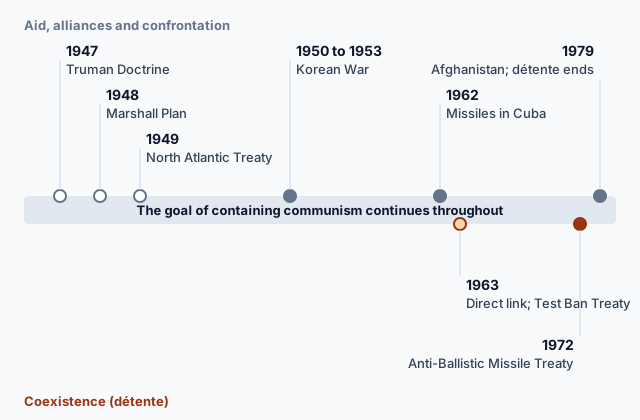 Tap to open the picture full size
Part 1 Think first Britain steps back
Commit to a guess first. Being wrong now makes the right idea stick better.
Predict first
On Friday, February 21, 1947, the British Embassy told the State Department that Great Britain could no longer give financial aid to the governments of Greece and Turkey. Greece faced a Communist-led insurgency, and Turkey's weak government faced Soviet pressure to share control of the Dardanelle Straits. What do you think the United States did?
In short. From 1945 to 1980 the United States kept one goal, containing Communist power, while its methods moved between aid, alliances, war in Korea and, by the early 1970s, agreements with the Soviet Union that eased tension.
- As the wartime alliance with the Soviet Union broke apart, the United States built a foreign policy of collective security, international aid and economic institutions that bolstered non-Communist nations.
- Concerned by expansionist Communist ideology and Soviet repression, the United States set out to contain communism, including by fighting a major war in Korea from 1950 to 1953.
- The Cold War swung between confrontation and coexistence: after the 1962 missile crisis came the agreements of 1963, détente in the 1970s, and its collapse after the Soviet invasion of Afghanistan in 1979.
Part 2 Learn it One goal, changing methods
2a. From allies to rivals
The United States and the Soviet Union fought World War II as allies. Postwar tensions dissolved that alliance. The Soviet Union took control of Eastern Europe, and Western European countries, wrecked by the war, looked open to Soviet expansion.
Truman's message of March 12, 1947, framed the contest as a choice: "At the present moment in world history nearly every nation must choose between alternative ways of life." One was free government. "The second way of life is based upon the will of a minority forcibly imposed upon the majority." He declared that "it must be the policy of the United States to support free peoples who are resisting attempted subjugation by armed minorities or by outside pressures."
That policy came to be called containment: stopping communism from spreading to more countries, by many means. Concerned by expansionist Communist ideology and Soviet repression, American leaders kept containment as their goal for decades. The National Archives notes that later presidents used the same reasoning to justify actions in Korea, Cuba and Vietnam.
Sources: Truman Doctrine (National Archives); Marshall Plan (National Archives).
Quick check · Fill the statement
Complete the notes on Truman's message of March 12, 1947.
Truman said nearly every nation must choose between two ways of life, and that the United States must support free peoples resisting outside pressure. That goal of stopping communism from spreading became known as . For Greece and Turkey, he said help should come mainly through aid.
2b. Aid, alliances and institutions
Containment used more than one tool. In a speech at Harvard on June 5, 1947, Secretary of State George Marshall proposed that European nations plan their own recovery, with American help. Congress overwhelmingly passed the act, Truman signed the Marshall Plan on April 3, 1948, and over the next four years Congress appropriated $13.3 billion for European recovery. That is international aid. The National Archives notes it also gave the United States markets for American goods and reliable trading partners, and supported stable democratic governments in Western Europe.
In April 1949 the United States joined the North Atlantic Treaty, which says "an armed attack against one or more of them in Europe or North America shall be considered an attack against them all." That is collective security: allies promising to defend one another.
Aid and alliances worked alongside economic institutions that bolstered non-Communist nations, such as the International Monetary Fund and the International Bank for Reconstruction and Development, set up under the Bretton Woods Agreements of July 1944 to promote the growth of international trade. Congress's approval of the Marshall Plan also signaled that the bipartisanship of World War II carried into the postwar years.
Sources: Marshall Plan (National Archives); North Atlantic Treaty (Avalon Project); Bretton Woods Agreements (Avalon Project).
Quick check · Match
Match each development of 1947 to 1949 to the part of Cold War policy it shows.
2c. Containment by war: Korea
Containment also meant fighting. After World War II, in 1948, Korea was divided between a Soviet-backed government in the north and an American-backed government in the south. On June 25, 1950, war broke out along the 38th parallel when North Korean troops attacked and headed south toward Seoul. The United Nations Security Council condemned the invasion as a "breach of the peace," and the United States and other UN member nations sent troops to defend South Korea.
The three-year conflict took the lives of millions of soldiers and civilians, including 36,576 Americans. The armistice signed on July 27, 1953, stopped the fighting, but it was not a permanent peace treaty. North and South Korea stayed separate, on almost the same territory they had held when the war began.
Korea was a major military engagement to contain communism. It ended close to where it started, with Korea still divided. Vietnam, in Topic 8.8, followed the same reasoning.
Quick check · Put it in order
Put these events of the Korean War in the order they happened, earliest first.
2d. Confrontation, then coexistence
The Cold War swung between direct and indirect military confrontation and periods of mutual coexistence, called détente.
Kennedy's inaugural of January 20, 1961, held both. "Let every nation know, whether it wishes us well or ill, that we shall pay any price, bear any burden, meet any hardship, support any friend, oppose any foe to assure the survival and the success of liberty." Then, "to those nations who would make themselves our adversary," he said: "Let us never negotiate out of fear. But let us never fear to negotiate."
Events, not the speech, pushed the swing. On October 14, 1962, U-2 photographs showed that the Soviet Union was installing medium-range nuclear missiles in Cuba. Kennedy told the nation on October 22, the United States put a naval blockade around Cuba, and the National Archives calls the standoff "the first direct nuclear confrontation in history." On October 28 the Soviets agreed to remove the missiles.
Having come that close to nuclear war, the two governments moved within a year to lower the risk. In June 1963 they agreed to set up a direct communications link for emergencies, and in August the United States, Great Britain and the Soviet Union signed the Limited Test Ban Treaty, banning nuclear tests in the atmosphere, in outer space and under water.
Sources: Kennedy's Inaugural Address (National Archives); Missiles in Cuba (National Archives); Direct Communications Link (Avalon Project); Test Ban Treaty (National Archives).
Quick check · Multiple choice
Kennedy's 1961 promise to "pay any price" opens "Let every nation know, whether it wishes us well or ill." He made his offer of talks "to those nations who would make themselves our adversary." How does that audience help explain why one speech carried both resolve and an offer to negotiate?
Part 3 Watch it done Source Truman's message to Congress
Watch each step, then do the last one yourself.
In his message of March 12, 1947, Truman told Congress: "At the present moment in world history nearly every nation must choose between alternative ways of life." Explain how the message's historical situation and purpose limit its use as evidence of how great the danger actually was.
Predict first
Before the steps, what do you think Truman most needed this speech to do?
Step 1 · Place it in time
On February 21, 1947, Britain said it could no longer aid Greece and Turkey. Greece faced a Communist-led insurgency, and Turkey faced Soviet pressure over the Dardanelle Straits. Truman needed money that only Congress could give.
Why this step?
Why does a source's purpose matter when you use it as evidence?
A source written to persuade picks and shapes its facts to win the audience over. Knowing the purpose tells you which claims to check before you rely on them.
Step 2 · Name the audience and purpose
In a meeting with State Department officials, members of Congress agreed to back the program on one condition: that Truman stress the severity of the crisis in an address to Congress and in a radio broadcast to the American people. The speech asked for $400 million.
Your step · Decide and justify
Finish it. How do the speech's situation and purpose limit what it can show?
Which evidence best supports your answer?
Part 4 Try it Détente in the 1970s, and its end
On May 26, 1972, the United States and the Soviet Union signed a treaty in Moscow limiting anti-ballistic missile systems. Its opening lines say the two powers were acting "Desiring to contribute to the relaxation of international tension and the strengthening of trust between States," and "Declaring their intention to achieve at the earliest possible date the cessation of the nuclear arms race."
Presidents of both parties spoke the same way. Richard Nixon, in January 1973: "We shall continue, in this era of negotiation, to work for the limitation of nuclear arms, and to reduce the danger of confrontation between the great powers." Jimmy Carter, in January 1977: "We pledge perseverance and wisdom in our efforts to limit the world's armaments to those necessary for each nation's own domestic safety."
Détente did not last. Looking back in 2001, a State Department official told NATO's parliamentary assembly that the promise of détente evaporated in 1979 with the Soviet invasion of Afghanistan.
Sources: ABM Treaty (Avalon Project); Nixon's Second Inaugural (Avalon Project); Carter's Inaugural (Avalon Project); Grossman address, 2001 (Avalon Project).
Try it · Multiple choice
What do the 1972 treaty and the speeches that followed show about continuity and change in Cold War policy in the 1970s?
Try it · Spot the error
A student writes a sourcing paragraph on the 1972 treaty. Which line is the first to go wrong?
Part 5 Explain it Write it like a document-based answer
Nothing you type leaves this page. Check your answer against the model and each scoring point.
Free-response practice · Question 1 style
A short practice in the shape of the document-based question: three documents instead of seven, and a thesis with one body paragraph instead of a full essay.
Evaluate the extent to which United States Cold War policy changed between 1947 and 1972.
Document 1. President Harry Truman, message to a joint session of Congress, March 12, 1947: "I believe that it must be the policy of the United States to support free peoples who are resisting attempted subjugation by armed minorities or by outside pressures."
Document 2. President John F. Kennedy, inaugural address, January 20, 1961: "Let every nation know, whether it wishes us well or ill, that we shall pay any price, bear any burden, meet any hardship, support any friend, oppose any foe to assure the survival and the success of liberty." Later, "to those nations who would make themselves our adversary": "Let us never negotiate out of fear. But let us never fear to negotiate."
Document 3. Treaty between the United States and the Soviet Union on the Limitation of Anti-Ballistic Missile Systems, signed at Moscow, May 26, 1972: "Desiring to contribute to the relaxation of international tension and the strengthening of trust between States"
Write a thesis, one sentence of historical context, and one paragraph that uses at least two documents and explains the purpose, audience, point of view or situation of one of them.
Model answer
Thesis: From 1947 to 1972 the goal of United States Cold War policy, containing Communist power, stayed the same, while its methods changed a good deal, from aid and confrontation toward negotiated limits on arms.
Context: after World War II the wartime alliance with the Soviet Union broke apart as the Soviet Union took control of Eastern Europe.
In 1947 Truman committed the nation to "support free peoples" against outside pressure (Document 1), and his aid to Greece and Turkey was followed by the Marshall Plan, the North Atlantic Treaty and war in Korea. Kennedy in 1961 kept that promise, pledging to "oppose any foe" (Document 2), but he also invited talks. Because he spoke to every nation, "well or ill," and made his offer to adversaries directly, his words had to warn the Soviet side and reassure allies at once, which explains why resolve and an offer to negotiate sit side by side. The swing toward talks came from events: after the missile crisis of 1962 brought the two powers to the edge of nuclear war, they agreed to a direct link and a test ban in 1963, and in 1972 signed a treaty in Moscow that aimed at "the relaxation of international tension" (Document 3). The treaty states intentions rather than proving results, but it shows that both governments now treated arms control as part of the rivalry. The rivalry continued; the methods changed.
Score your own answer. This is a self-check, not a grade. Tick each point your answer makes.
Part 6 Check yourself Twenty-five years of the Cold War
The case questions use the table. The others mix the ideas from the whole lesson.
Seven developments from 1947 to 1972. Sources: Truman Doctrine; Marshall Plan; North Atlantic Treaty; Korean War Armistice; Missiles in Cuba; Test Ban Treaty; ABM Treaty.
| Year | Development |
|---|---|
| 1947 | Truman asks for military and economic aid for Greece and Turkey |
| 1948 | The Marshall Plan begins four years of aid for European recovery |
| 1949 | The United States signs the North Atlantic Treaty with nations of Western Europe |
| 1950 to 1953 | The United States and other UN members fight in Korea |
| 1962 | U-2 photographs show Soviet missiles in Cuba, and a naval blockade follows |
| 1963 | A direct communications link, and the Limited Test Ban Treaty |
| 1972 | The United States and the Soviet Union limit anti-ballistic missile systems |
Case question 1 · Multiple choice
Which row is the clearest example of collective security?
Case question 2 · Sort it
Tap each development from the table, then the side of the Cold War's swings it belongs to.
Military confrontation
Coexistence
The rest stand on their own and do not use the case.
Check yourself · Select all
Which two describe continuities in United States Cold War policy from 1947 to the 1970s? Select two.
Select 2 answers, then check.
Check yourself · Fill the statement
Complete the sentences about how the Korean War ended.
The armistice of July 27, 1953, stopped the fighting, but it was not a permanent . North and South Korea stayed , on almost the same territory they had held when the war began.
Part 7 Keep it Bring back earlier ideas
This lesson stands on the forces of Period 8 from Topic 8.1 and on the end of World War II from Topic 7.13.
Bring it back · Multiple choice
A historian argues that Cold War policies changed American life at home as well as abroad. Which development best supports that argument?
Bring it back · Fill the statement
Complete the sentences about how World War II ended.
The United States and its allies won through Allied cooperation, scientific and technological advances, and campaigns such as the D-Day invasion. The use of bombs hastened the end of the war and sparked debates about the of using such weapons.
In three lines
- Containing communism was the goal from 1947 through the 1970s; aid, alliances, economic institutions and war were the methods.
- Korea was a major war to contain communism that ended near where it began, with an armistice and no peace treaty.
- The 1962 missile crisis pushed the rivals toward coexistence; the agreements of 1963 and 1972 eased tension without ending the rivalry, and détente evaporated in 1979.
Exam strategy for this topic
- Section I Part A, Multiple Choice: 55 questions in 55 minutes.
- Section I Part B, Short Answer: 3 questions in 40 minutes.
- Section II, Document-Based Question and Long Essay: 2 questions in 100 minutes.
- This lesson's Explain it is shaped like free-response question 1, Document-based.
When a question asks about continuity and change in Cold War policy, separate the goal from the methods: containment continued, while the tools moved between aid, alliances, war and arms control.
Questions students ask
What was the Truman Doctrine?
Truman's message to Congress of March 12, 1947, asking for $400 million in military and economic aid for Greece and Turkey and declaring that the United States must support free peoples resisting outside pressure. The National Archives notes it guided U.S. foreign policy for the next 40 years.
Why did the United States fight in Korea?
When North Korean troops attacked across the 38th parallel on June 25, 1950, the UN Security Council condemned the invasion, and the United States and other UN members sent troops to defend South Korea. It was a war to contain communism.
Did the Korean War ever officially end?
The armistice of July 27, 1953, stopped the fighting, but it was not a permanent peace treaty. North and South Korea remain separate, on almost the same territory they held when the war began.
Is détente the same as the end of the Cold War?
No. Détente was an easing of tension inside the rivalry. The 1972 treaty itself speaks of a hope to end the nuclear arms race, which shows the race was still going on, and détente evaporated after the Soviet invasion of Afghanistan in 1979.
Where can I read these documents in full?
Each excerpt links to its full text at the National Archives or the Avalon Project at Yale Law School, the primary-source collections this lesson was checked against.
Course alignment, for teachers
AP U.S. History topic 8.2, Unit 8: Period 8: 1945–1980.
- Skill 2.C: Explain the significance of a source’s point of view, purpose, historical situation, and/or audience, including how these might limit the use(s) of a source.
This lesson maps all 4 essential knowledge statements of the topic, and the one learning objective with none of its own, to the part that teaches each one: 5 are checked by a scored question. The map is in the lesson file.