Unit 3 · Topic 3.5 · about 30 minutes · 7 parts · 11 scored checks, 4 of them multiple choice, plus 2 from earlier lessons
AP U.S. History 3.5: The American Revolution
Unit 3: 10 to 17% of the multiple-choice section
What you'll be able to do
- Explain how various factors contributed to the American victory in the Revolution, and support an argument about the victory with specific and relevant evidence from the documents of the war.
Key vocabulary
| Term | What it means | The exam trap |
|---|---|---|
| Loyalists | Colonists who stayed loyal to the British crown during the Revolution; some fought in the British army. | Loyalists were Americans, not British soldiers sent from overseas. |
| Militia | A local force of armed citizens raised by a colony or state, rather than by Congress. | A militia is not the Continental Army; the two fought side by side but were raised by different governments. |
| Continental Army | The army of the United Colonies, raised by Congress, with George Washington as its commander in chief from June 1775. | Continental means belonging to all the colonies together, not to the European continent. |
| Treaty of Alliance (1778) | The defensive alliance between the United States and France, whose aim was to secure American independence. | It is not the Treaty of Paris of 1783, the peace with Britain. |
| Specific and relevant evidence | Evidence that names something a reader can check, such as a document, date or person, and that connects to the claim it supports. | Specific evidence can still be irrelevant: a true fact about militias does not support a claim about allies. |
 Tap to open the picture full size
Part 1 Think first Who took the surrender?
Commit to a guess first. Being wrong now makes the right idea stick better.
Predict first
In October 1781 the British garrisons at York and Gloucester, Virginia, under Earl Cornwallis, surrendered. Britain had begun the war with what looked like overwhelming military and financial advantages, and it had hired soldiers from German states. Guess before you read on: to whom did those garrisons surrender?
In short. The Patriots won despite considerable loyalist opposition and Britain's apparently overwhelming military and financial advantages, because colonial militias, the Continental Army, George Washington's leadership, the colonists' commitment and resilience, and help from European allies worked together.
- Britain could hire soldiers from German states, and many colonists stayed loyal to the crown; some joined the British army.
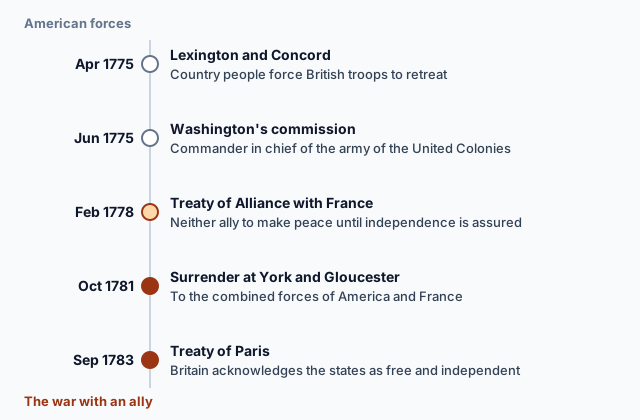
- Militias turned out from the first day of fighting, and in June 1775 Congress made George Washington commander in chief of a Continental Army.
- France allied with the United States in 1778, and the British army at York surrendered in 1781 "to the combined forces of America and France."
Part 2 Learn it How the Patriots won
2a. Britain's advantages, and the loyalists
Britain went to war with what looked like overwhelming military and financial advantages. It could also buy soldiers: in May 1776 Congress learned that the king had arranged with German states to hire soldiers to fight in America. Five years later the British garrison at York, Virginia, still counted "British, Anspach, and Hessian" regiments among its men.
Not every colonist was a Patriot. Loyalists were colonists who stayed loyal to the British crown, and there were enough of them to make considerable opposition. Some fought for Britain. One article of the surrender terms at York in October 1781 asked that "Natives or inhabitants of different parts of this country, at present in York or Gloucester, are not to be punished on account of having joined the British army." The answer written beside it: "This article cannot be assented to, being altogether of civil resort." The generals would not promise anything; Americans who had fought for Britain were left to the civil authorities.
So the Patriots fought a strong empire and a divided population at once. That is the problem every explanation of the victory has to solve.
Sources: The Declaration of Independence: A History (National Archives); Articles of Capitulation, 1781 (Avalon Project).
Quick check · Sort it
Each card describes something from the war. Tap a card, then the side it helped.
Helped Britain
Helped the Patriots
2b. Militias, an army and a commander
Two kinds of American force fought the war. A militia was a local force of armed citizens, raised by a colony and later by a state. The Continental Army was the army of all the colonies together, raised by Congress.
Militias fought first. Congress's account of April 19, 1775 says British troops marched to Lexington and Concord, "until compelled to retreat by the country people suddenly assembled to repel this cruel aggression." That is Congress telling its own side of the story. The states kept such forces: the Articles of Confederation, in force from 1781, said "every State shall always keep up a well-regulated and disciplined militia, sufficiently armed and accoutered."
On June 17, 1775, Congress named George Washington "General and Commander in chief, of the army of the United Colonies." His commission charged him with "causing strict discipline and order to be observed in the army, and that the soldiers be duly exercised." These papers show the job Congress gave him, not how well he did it. Evidence of his leadership in action comes later: in 1781 he commanded the combined American and French forces at York. Washington's military leadership was one of the reasons the Patriot cause succeeded.
Sources: Causes and Necessity of Taking Up Arms, 1775 (Avalon Project); Articles of Confederation (Avalon Project); Commission for General Washington, 1775 (Avalon Project).
Quick check · Fill the statement
Complete the notes on the American forces.
Armed local citizens raised by a colony or state made up its . The army Congress raised for all the colonies was the , and in June 1775 Congress made George Washington its .
2c. Commitment and resilience
Armies are made of people who choose to keep fighting. Ideological commitment is belief in the cause itself, here the ideas of rights and self-government from Topic 3.4. Resilience is the ability to keep going after losses and hard years.
In July 1775 Congress set out the colonists' case: "Our cause is just. Our union is perfect. Our internal resources are great, and, if necessary, foreign assistance is undoubtedly attainable." Read it as evidence of what Congress believed and wanted readers to believe, not as a measure of real strength. Congress itself had first met only the September before, so the sentence is a statement of confidence meant to rally people.
The same declaration promised that the colonists would, "in defiance of every hazard, with unabating firmness and perseverence, employ for the preservation of our liberties" the arms they had taken up (spelling as printed). A promise is not proof. The evidence of resilience is what happened next: the war lasted from 1775 to 1783, through three years of fighting before any ally joined, and the Patriots did not make peace until Britain acknowledged independence.
Sources: Causes and Necessity of Taking Up Arms, 1775 (Avalon Project); Treaty of Paris (National Archives).
Quick check · Match
Match each piece of evidence to the factor in the American victory it best supports.
2d. Help from Europe
France signed a Treaty of Alliance with the United States on February 6, 1778. Benjamin Franklin, Silas Deane and Arthur Lee negotiated it in France, and the National Archives says it formalized France's financial and military support of the revolutionary government. Article 2 states the aim: "The essential and direct End of the present defensive alliance is to maintain effectually the liberty, Sovereignty, and independance absolute and unlimited of the said united States, as well in Matters of Gouvernement as of commerce." (spelling as printed). Each side promised "not to lay down their arms, until the Independence of the united states shall have been formally or tacitly assured."
The help showed at the end. The terms at York, headed October 18 and signed October 19, 1781, were settled between Washington, the French general the Count de Rochambeau, and the Count de Grasse, "Commander-in-Chief of the Naval Army of France in the Chesapeake." The garrisons were "to surrender themselves prisoners of war to the combined forces of America and France." The National Archives adds that the war became a world conflict, drawing in Spain and the Netherlands as well as France.
In the Treaty of Paris of September 3, 1783, Britain acknowledged the states "to be free sovereign and independent states."
Sources: Treaty of Alliance, 1778 (Avalon Project); Treaty of Alliance with France (National Archives); Articles of Capitulation, 1781 (Avalon Project); Treaty of Paris, 1783 (Avalon Project).
Quick check · Multiple choice
In the Treaty of Alliance of 1778, France and the United States agreed "not to lay down their arms, until the Independence of the united states shall have been formally or tacitly assured." Which conclusion does this evidence best support?
Part 3 Watch it done Support a claim about allies
Watch each step, then do the last one yourself.
Claim: help from European allies was one reason the Patriot cause succeeded. Support the claim with specific and relevant evidence.
Predict first
Before the steps, which kind of evidence do you think will support the claim best?
Step 1 · Make the evidence specific
Specific evidence names a document, a date and the people in it. The surrender terms of October 1781 at York were settled between Washington, as "Commander-in-Chief of the combined Forces of America and France," the Count de Rochambeau, and the Count de Grasse, commander of the French fleet in the Chesapeake.
Why this step?
Why not just write that France helped?
That sentence only repeats the claim. Evidence is something a reader can check, such as a named document and what it says.
Step 2 · Make it relevant
Relevant evidence connects to the claim's own words. Ask of each detail which part of the claim it speaks to: allies, helping, or the cause succeeding. A detail can be specific and accurate and still speak to none of them.
Your step · Decide and justify
Finish it. Which sentence best explains how the evidence from York supports the claim?
Which detail from the surrender terms best supports your answer?
Part 4 Try it The peace, and the loyalists
John Adams, Benjamin Franklin and John Jay negotiated the peace for the United States. In the Treaty of Paris, signed September 3, 1783, Britain acknowledged the states "to be free sovereign and independent states." Article 5 said "Congress shall earnestly recommend" to the states "the restitution of all estates, rights, and properties, which have been confiscated belonging to real British subjects," and the same for "persons resident in districts in the possession on his Majesty's arms and who have not borne arms against the said United States" (spelling as printed). Restitution means giving back, and the treaty could only ask the states for it, not order it.
Sources: Treaty of Paris, 1783 (Avalon Project); Treaty of Paris (National Archives).
Try it · Multiple choice
Article 5 of the Treaty of Paris asks the states to give back property confiscated during the war from British subjects and from people in British-held districts. Which part of the history of the war does this provision most directly reflect?
Now read a student's paragraph that uses the documents of this lesson as evidence about Washington. Check each line against what the documents say.
Try it · Spot the error
A student supports the claim that Washington's leadership helped the Patriots win. Which line is the first to go wrong?
Part 5 Explain it Write it like a document-based answer
Nothing you type leaves this page. Check your answer against the model and each scoring point.
Free-response practice · Question 1 style
A short practice in the shape of the document-based question: three documents instead of seven, and a thesis with one body paragraph instead of a full essay.
Evaluate the extent to which help from France was responsible for the American victory in the Revolution.
Document 1. Declaration of the Causes and Necessity of Taking Up Arms, issued by Congress at Philadelphia, July 6, 1775: "Our cause is just. Our union is perfect. Our internal resources are great, and, if necessary, foreign assistance is undoubtedly attainable."
Document 2. Treaty of Alliance between the United States and France, February 6, 1778, Article 2: "The essential and direct End of the present defensive alliance is to maintain effectually the liberty, Sovereignty, and independance absolute and unlimited of the said united States, as well in Matters of Gouvernement as of commerce." (spelling as printed)
Document 3. Articles of Capitulation at York and Gloucester, Virginia, October 18, 1781: the British garrisons were "to surrender themselves prisoners of war to the combined forces of America and France."
Write a thesis, one sentence of historical context, and one paragraph that uses at least two documents and explains the purpose, audience, point of view or situation of one of them.
Model answer
Thesis: French help was a major reason for the American victory and was decisive at its end, but it built on American militias, a Continental Army under Washington, and a commitment to the cause that had kept the war going for three years before the alliance.
Context: Britain began the war with what looked like overwhelming military and financial advantages, could hire soldiers from German states, and had the support of many loyal colonists.
In July 1775, with no ally at all, Congress claimed "Our cause is just" and "Our internal resources are great," and said foreign help was only "undoubtedly attainable" if needed (Document 1). Congress wrote this to rally Americans and to persuade readers that the cause could win, so it shows commitment more than real strength, but it shows Americans fighting on their own first. By 1778 France had bound itself to fight for American "independance absolute and unlimited" (Document 2), and in 1781 the British garrisons at York surrendered "to the combined forces of America and France" (Document 3). French help was decisive at the end, yet the word "combined" shows it joined an American army already in the field, so it was one factor among several.
Score your own answer. This is a self-check, not a grade. Tick each point your answer makes.
Part 6 Check yourself The surrender at York
The case questions use the two articles. The others mix the ideas from the whole lesson.
Two articles from the surrender terms of October 1781, with the answer the American and French side wrote to the second. Source: Articles of Capitulation, 1781 (Avalon Project).
| Article | Text |
|---|---|
| Article I | The garrisons were "to surrender themselves prisoners of war to the combined forces of America and France." |
| Article X, and its answer | "Natives or inhabitants of different parts of this country, at present in York or Gloucester, are not to be punished on account of having joined the British army." Answer: "This article cannot be assented to, being altogether of civil resort." |
Case question 1 · Multiple choice
Article I is the most direct evidence for which factor in the American victory?
Case question 2 · Multiple choice
What do Article X and its answer show?
The rest stand on their own and do not use the case.
Check yourself · Put it in order
Put these events in the order they happened, earliest first.
Check yourself · Select all
A student claims that the colonists' ideological commitment helped the Patriot cause succeed. Which two pieces of evidence are most relevant to that claim? Select two.
Select 2 answers, then check.
Part 7 Keep it Bring back earlier ideas
This lesson stands on the change in colonial ideas from Topic 3.4: the rights the Patriots were fighting for.
Both excerpts come from the colonies' Congress at Philadelphia, a year apart. Sources: 1775 declaration (Avalon Project); Declaration of Independence (National Archives).
| Document | Excerpt |
|---|---|
| Declaration of the Causes and Necessity of Taking Up Arms, July 6, 1775 | "Lest this declaration should disquiet the minds of our friends and fellow-subjects in any part of the empire, we assure them that we mean not to dissolve that union which has so long and so happily subsisted between us, and which we sincerely wish to see restored." |
| Declaration of Independence, July 4, 1776 | "That these United Colonies are, and of Right ought to be Free and Independent States; that they are Absolved from all Allegiance to the British Crown" |
From 3.4 Philosophical Foundations of the American Revolution · Multiple choice
The 1775 excerpt is addressed most directly to which audience?
From 3.4 Philosophical Foundations of the American Revolution · Put it in order
Put these events in the order they happened, earliest first.
In three lines
- The Patriots faced considerable loyalist opposition and Britain's apparently overwhelming military and financial advantages.
- Militias, the Continental Army, Washington's leadership, and the colonists' commitment and resilience kept the war going from 1775.
- The French alliance of 1778 brought help that was decisive at York in 1781, and Britain acknowledged independence in 1783.
Exam strategy for this topic
- Section I Part A, Multiple Choice: 55 questions in 55 minutes.
- Section I Part B, Short Answer: 3 questions in 40 minutes.
- Section II, Document-Based Question and Long Essay: 2 questions in 100 minutes.
- This lesson's Explain it is shaped like free-response question 1, Document-based.
When a question asks why the Patriots won, name at least two factors and give one specific piece of evidence for each, then say how they worked together.
Questions students ask
Why did France join the war?
The Treaty of Alliance names its aim in Article 2: to maintain the "independance absolute and unlimited" of the United States. It was written for a war between France and Britain, and its first article applies if war breaks out between them during the American war.
Were most colonists Patriots?
Many were, but loyalist opposition was considerable. Some Americans joined the British army, the surrender terms at York had to deal with them, and the peace of 1783 asked the states to return property they had confiscated.
What did the Treaty of Paris of 1783 do?
It ended the war. Britain acknowledged the states "to be free sovereign and independent states," and the treaty settled boundaries and other questions. John Adams, Benjamin Franklin and John Jay negotiated it for the United States.
Why does a quotation spell independence as "independance"?
Every excerpt is copied exactly as the archive prints it, so you can check it against the source linked beside it.
Where can I read these documents in full?
Each excerpt links to its full text at the Avalon Project at Yale Law School or the National Archives, the primary-source collections this lesson was checked against.
Course alignment, for teachers
AP U.S. History topic 3.5, Unit 3: Period 3: 1754–1800.
- Skill 6.B: Support an argument using specific and relevant evidence.
This lesson maps the one essential knowledge statement of the topic, and the one learning objective with none of its own, to the part that teaches each one: 2 are checked by a scored question. The map is in the lesson file.