Unit 4 · Topic 4.11 · about 30 minutes · 7 parts · 13 scored checks, 5 of them multiple choice
AP U.S. History 4.11: An Age of Reform
Unit 4: 10 to 17% of the multiple-choice section
What you'll be able to do
- Explain how and why various reform movements developed and expanded from 1800 to 1848, and identify the evidence reformers and their records used to support an argument.
Key vocabulary
| Term | What it means | The exam trap |
|---|---|---|
| Second Great Awakening | A wave of Protestant religious revivals in the early 1800s that influenced reform and new religious movements. | It describes a religious revival; the reforms it inspired were carried out by many groups, some with no religious aim at all. |
| Voluntary organization | A society that people chose to join in order to change behavior or improve society, run outside government. | Do not confuse a voluntary organization with a government agency; ask who founded and ran it. |
| Temperance | The movement to reduce or end the drinking of alcohol. | Temperance was about drinking, not about religion as such, though many of its supporters were moved by faith. |
| Gradual emancipation | Ending slavery by law over a period of years rather than all at once. | Read a gradual law closely before you say whom it covered and when. |
| Gag rule | A rule of the House of Representatives that set aside every petition about abolishing slavery without considering it. | It was a rule of the House of Representatives, not a law passed by Congress as a whole. |
| Declaration of Sentiments | The list of demands for women's rights issued by the convention at Seneca Falls, New York, in 1848. | Do not confuse it with other declarations of the period; check who issued it and when. |
 Tap to open the picture full size
Part 1 Think first Why keep sending petitions nobody would read?
Commit to a guess first. Being wrong now makes the right idea stick better.
Predict first
From 1836 to 1844, a rule of the U.S. House of Representatives said that no petition about abolishing slavery would be considered at all. Every one that arrived was set aside unread. Antislavery Americans kept sending them anyway, by the hundreds. Why do you think they kept at it?
In short. Between 1800 and 1848, a Protestant revival and the upheaval of the market revolution moved many Americans to join voluntary societies that tried to change individual behavior and improve society, from temperance to the end of slavery to equal rights for women.
- The Second Great Awakening influenced moral and social reform, and it also inspired utopian communities and new religious movements.
- Northern states ended slavery gradually, so the free African American population grew, even as many states restricted African Americans' rights; antislavery societies, newspapers and petitions spread across the North.
- In 1848 a women's rights convention at Seneca Falls, New York, issued a Declaration of Sentiments modeled on the Declaration of Independence.
Part 2 Learn it How and why reform spread
2a. Revival, reform and new communities
The Second Great Awakening was a wave of Protestant revivals in the early 1800s. Democratic and individualistic beliefs, a reaction against rationalism, and the changes the market revolution brought all contributed to it, as Americans moved and changed work more often.
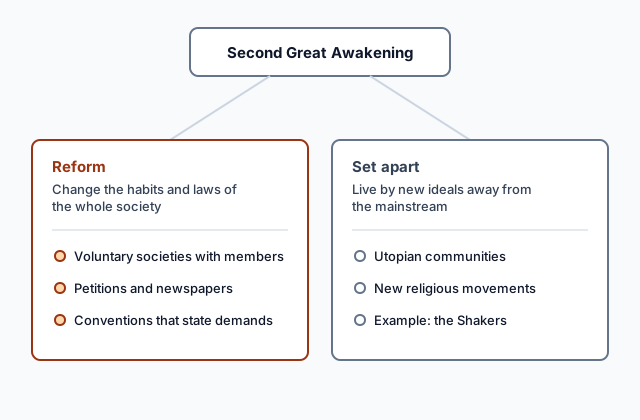
The Awakening pushed people in two directions. One was reform: changing behavior and society through temperance, antislavery and other causes, the subject of the rest of this lesson. The other was to step outside ordinary society. The Awakening also inspired utopian communities and other religious movements. The course framework's examples include the Shakers, a religious movement; Brook Farm, a community of the 1840s that combined farm work, study and spiritual life, and Fruitlands, a farming community built on transcendentalist ideas.
Sojourner Truth's narrative, published in 1850, describes believers in the Second Advent near Hartford, Connecticut, who expected "the immediate personal appearance of Jesus Christ." Truth herself "attended two camp-meetings of the believers in these doctrines." Camp meetings, large outdoor religious gatherings, were one of the marks of the Awakening.
Sources: The Narrative of Sojourner Truth, 1850 (Avalon Project). The Shakers, Brook Farm and Fruitlands are among the examples the AP U.S. History course framework gives for this topic.
Quick check · Sort it
The Second Great Awakening pushed Americans in two directions. Tap a card, then the direction it shows.
Reform aimed at changing society
A community or movement set apart
2b. Voluntary societies and temperance
Most reformers worked outside government, through voluntary organizations, societies that people chose to join in order to change individual behavior and improve society. The course framework's examples show the range. Protestant ministers founded the American Bible Society in 1816 to spread the Bible more widely. William Lloyd Garrison and Arthur Tappan founded the American Anti-Slavery Society in 1833. Women formed societies of their own, such as the Daughters of Temperance.
Temperance, the campaign against drinking alcohol, was one of the largest causes. Its first aim, like that of the other societies, was to change how individuals behaved. But temperance reformers also pressed government. The National Archives' guide to House records notes that the years 1839 to 1843 brought petitions asking Congress to raise the duties on liquor, "a measure intended to reduce consumption rather than increase domestic production." Citizens of Wayne County, New York, also asked that liquor no longer be furnished to the Army and Navy or sold in Washington, DC.
When you read a reform source, separate its argument (drinking does harm, so the nation should drink less) from its evidence, the facts it offers in support.
Sources: Guide to House Records, Chapter 7 (National Archives). The founding dates of the two societies are from the AP U.S. History course framework's examples for this topic.
Quick check · Fill the statement
Complete a student's claim and the evidence for it.
Claim: temperance, like the other voluntary societies, aimed first at , but its reformers also pressed government. Evidence: between 1839 and 1843, petitions asked Congress to .
2c. Gradual emancipation and a growing antislavery movement
Northern states ended slavery slowly, by law. Pennsylvania's 1780 Act for the Gradual Abolition of Slavery freed no one who was already enslaved. A child born to an enslaved mother after the act was not a slave, but served as a servant until age 28. In New York, Sojourner Truth's narrative says the state's law freed her in 1828. This gradual emancipation steadily increased the free African American population of the North.
Freedom did not bring equal rights; many state governments restricted African Americans' rights. In 1813 James Forten, a free Black businessman in Philadelphia, wrote public letters against a bill in Pennsylvania's senate that proposed to ban people of color from the state.
Antislavery movements grew in the North. Garrison's newspaper, The Liberator, first appeared on January 1, 1831. In Baltimore, the young Frederick Douglass, still enslaved, read in a city newspaper that "a vast number of petitions and memorials had been presented to congress, praying for the abolition of slavery in the District of Columbia, and for the abolition of the slave trade between the states of the Union." From 1836 to 1844 the House tabled every such petition under its gag rule, and they kept coming.
Sources: Pennsylvania's Gradual Abolition Act, 1780 (Avalon Project); Narrative of Sojourner Truth (Avalon Project); My Bondage and My Freedom (Avalon Project). Forten's letters and The Liberator's date are from the AP U.S. History course framework's examples.
Quick check · Multiple choice
Under Pennsylvania's 1780 Act for the Gradual Abolition of Slavery, what happened to a child born in the state to an enslaved mother after the act passed?
2d. Seneca Falls and the rights of women
Some women in reform societies began to ask for rights of their own. In July 1848, Elizabeth Cady Stanton and Lucretia Mott organized the first women's rights convention, at Seneca Falls, New York. It produced a list of demands called the Declaration of Sentiments. The National Archives describes it: "Modeled on the Declaration of Independence, it called for broader educational and professional opportunities for women and the right of married women to control their wages and property." After Seneca Falls, the vote for women became a central issue.
The causes overlapped. Many who attended were also abolitionists. Frederick Douglass was there, and that year his antislavery newspaper, The North Star, argued that "there can be no reason in the world for denying to woman the elective franchise," the right to vote.
The alliance did not last. Many at Seneca Falls were abolitionists "whose goals included universal suffrage," the vote for all adults. The course framework notes that over time, arguments emerged over whether to narrow the movement's goals to white women. Long after 1848, when the Fifteenth Amendment opened the vote to Black men but not to women, suffragists split. In 1869 Stanton and Susan B. Anthony formed one organization, which opposed the amendment because it excluded women; a second, founded by Lucy Stone and others, supported it.
Source: Woman Suffrage and the 19th Amendment (National Archives).
Quick check · Match
Match each piece of evidence about the women's rights movement to the claim it best supports.
Part 3 Watch it done Find the evidence in Douglass's account
Watch each step, then do the last one yourself.
In My Bondage and My Freedom (1855), Frederick Douglass recalls how, as an enslaved boy in Baltimore, he decided which side the abolitionists were on, though he had never read their writings. He concluded that abolition "could not be unfriendly to the slave, nor very friendly to the slaveholder." Identify the evidence his conclusion rests on.
Predict first
Before the steps, where do you think an enslaved boy with no abolitionist books found his evidence?
Step 1 · Find the claim
The claim is the conclusion the writer wants you to accept. Here it is that abolition "could not be unfriendly to the slave, nor very friendly to the slaveholder."
Why this step?
Why find the claim before you look for evidence?
Evidence is always evidence for something. Until you know what a writer is arguing, you cannot tell which details support it and which are background.
Step 2 · Find what the claim rests on
Douglass listened to the people who held him. When an enslaved person escaped, slaveholders said the abolitionists had helped; when one struck back, "it was certain to be said, that such a crime was the legitimate fruits of the abolition movement." If slaveholders blamed the abolitionists for every escape, the abolitionists had to be against slavery. His evidence is his enemies' own complaints.
Your step · Decide and justify
Finish it. Douglass next read in a Baltimore newspaper that "a vast number of petitions and memorials had been presented to congress, praying for the abolition of slavery in the District of Columbia, and for the abolition of the slave trade between the states of the Union." What role does this report play in his account?
Which detail best supports your answer?
Part 4 Try it Abolitionists in court: the Amistad
In February 1839, slave hunters kidnapped a large group of Africans from Sierra Leone and shipped them to Havana, Cuba, where two Spanish plantation owners put them aboard the schooner Amistad. "On July 1, 1839, the Africans seized the ship." On August 24, a U.S. brig seized the Amistad off Long Island, New York, and the Africans were jailed in Connecticut while the planters, the government of Spain and the brig's commander claimed them, or money for them. President Martin Van Buren favored sending them back to Cuba.
According to the National Archives, "abolitionists in the North opposed extradition and raised money to defend the Africans." They hired lawyers, among them Roger S. Baldwin of New Haven. The lawyers' answer to the claims said that "each of them are natives of Africa and were born free," and that they had been "incited by the love of liberty natural to all men" to take the ship. Before the Supreme Court in 1841, the former president John Quincy Adams argued their case, "referring to treaties prohibiting the slave trade and to the Declaration of Independence." The Court ruled that the Africans were free, and thirty-five survivors returned home. The National Archives adds that abolitionists used the case to expose the evils of slavery and to build opposition to it.
Source: The Amistad Case (National Archives). The AP U.S. History course framework lists the Amistad case among its examples for this topic.
Try it · Multiple choice
The Africans' lawyers argued that the Africans were free people who could not be claimed as property. Which evidence did they use to support that argument?
Try it · Spot the error
A student writes about what the Amistad case shows about the antislavery movement. Which line is the first to go wrong?
Part 5 Explain it Write it like a document-based answer
Nothing you type leaves this page. Check your answer against the model and each scoring point.
Free-response practice · Question 1 style
A short practice in the shape of the document-based question: three documents instead of seven, and a thesis with one body paragraph instead of a full essay.
Evaluate the extent to which reformers from 1800 to 1848 worked outside government to change American society.
Document 1. Guide to House records (National Archives), describing petitions sent to Congress from 1839 to 1843: petitions asked Congress to raise the duties on liquor, "a measure intended to reduce consumption rather than increase domestic production."
Document 2. Frederick Douglass, My Bondage and My Freedom (1855), recalling what he read in a Baltimore newspaper while he was enslaved: "a vast number of petitions and memorials had been presented to congress, praying for the abolition of slavery in the District of Columbia, and for the abolition of the slave trade between the states of the Union."
Document 3. The National Archives, describing the Amistad case of 1839 to 1841: "abolitionists in the North opposed extradition and raised money to defend the Africans."
Write a thesis, one sentence of historical context, and one paragraph that uses at least two documents and explains the purpose, audience, point of view or situation of one of them.
Model answer
Thesis: Reformers from 1800 to 1848 organized almost entirely outside government, in societies, churches and newspapers, but the reforms that needed a change in law pushed them to press Congress and the courts.
Context: the Second Great Awakening, together with the changes of the market revolution, led many Americans to believe they could improve themselves and their society.
Reformers raised their own money and acted on their own: when the Amistad Africans were jailed, Northern abolitionists "raised money to defend the Africans" and hired lawyers, though their fight then went through the courts (Document 3). Temperance began with individual behavior, yet by 1839 temperance reformers were asking Congress to raise liquor duties to reduce consumption (Document 1). Antislavery reformers did the same on a larger scale: Douglass read of "a vast number of petitions and memorials" sent to Congress (Document 2). Douglass wrote as an abolitionist in 1855, years later, to persuade readers against slavery, so his memory of that report may stress the movement's strength; still, the House's gag rule of 1836 to 1844, which tabled such petitions as they kept arriving, shows that they did reach Congress. Reformers organized outside government, then carried their causes to it.
Score your own answer. This is a self-check, not a grade. Tick each point your answer makes.
Part 6 Check yourself The fight over the gag rule
The case questions use the two excerpts. The others mix the ideas from the whole lesson.
Both excerpts are from the National Archives' guide to the records of the House of Representatives, which counts "hundreds of petitions" on slavery tabled under the rule. Source: Guide to House Records, Chapter 14 (National Archives).
| Topic | Excerpt |
|---|---|
| The rule | "Between 1836 and 1844, the 21st rule of the House (the so-called gag rule) provided that no petition relating to the abolition of slavery would be entertained in any way; therefore, all such petitions and memorials received during that period were tabled." |
| The protest | "The earliest petitions referred to the committee toward the end of the era of the gag rule protest the rule itself. They maintain that the rule impaired the constitutional right of the people to petition Congress for a redress of grievances." |
Case question 1 · Multiple choice
Which conclusion do the two excerpts, taken together, best support?
Case question 2 · Multiple choice
The guide counts hundreds of petitions about slavery tabled in the House between 1836 and 1844. Which development best explains why so many arrived?
The rest stand on their own and do not use the case.
Check yourself · Put it in order
Put these events in the order they happened, earliest first.
Check yourself · Select all
Which two describe the free African American population of the North from 1800 to 1848? Select two.
Select 2 answers, then check.
Part 7 Keep it Bring back earlier ideas
This lesson stands on the causes of the Second Great Awakening from Topic 4.10 and the growth of democracy from Topic 4.7.
Bring it back · Multiple choice
A historian lists conditions in the early 1800s that helped spark the Protestant revivals of the Second Great Awakening. Which belongs on the list?
Bring it back · Fill the statement
Read the situation, then complete the sentences.
Suppose a state in the 1820s, where only white men may vote, drops its rule that a voter must own property. Afterward, may vote for the first time, while still may not.
In three lines
- The Second Great Awakening led many Americans into reform, and it inspired utopian communities and new religious movements.
- Voluntary societies worked on temperance, antislavery and other causes, mostly outside government, though they petitioned Congress too.
- Northern emancipation was gradual, antislavery grew in the North, and the Seneca Falls convention of 1848 stated the case for women's rights.
Exam strategy for this topic
- Section I Part A, Multiple Choice: 55 questions in 55 minutes.
- Section I Part B, Short Answer: 3 questions in 40 minutes.
- Section II, Document-Based Question and Long Essay: 2 questions in 100 minutes.
- This lesson's Explain it is shaped like free-response question 1, Document-based.
When a question asks for the evidence in a source, point to the facts the author gives, not the conclusion the author draws. Say what claim each fact is offered to support.
Questions students ask
What was the Second Great Awakening?
A wave of Protestant revivals in the early 1800s. It grew out of democratic and individualistic beliefs, a reaction against rationalism, and the changes of the market revolution, and it led many Americans into reform, utopian communities and new religious movements.
Did the North end slavery right after the Revolution?
Gradually. Pennsylvania's law of 1780 freed children born after it passed, once they had served until age 28, and freed no one already enslaved. Sojourner Truth, enslaved in New York, was freed by that state's law in 1828, by her narrative's account.
Why did reformers send petitions to a Congress that would not read them?
Petitions let ordinary people organize and be counted. The House tabled every antislavery petition from 1836 to 1844, and the petitions kept coming until the rule ended in 1844.
What did the Seneca Falls convention ask for?
Its Declaration of Sentiments, modeled on the Declaration of Independence, called for wider opportunities for women in education and the professions and for married women's control of their own wages and property. The vote became a central issue after the convention.
Where can I read these sources in full?
Each excerpt links to its full text at the National Archives or the Avalon Project at Yale Law School, the collections this lesson was checked against.
Course alignment, for teachers
AP U.S. History topic 4.11, Unit 4: Period 4: 1800–1848.
- Skill 3.B: Identify the evidence used in a source to support an argument.
This lesson maps all 5 essential knowledge statements of the topic, and the one learning objective with none of its own, to the part that teaches each one: 6 are checked by a scored question. The map is in the lesson file.