Unit 4 · Topic 4.5 · about 30 minutes · 7 parts · 13 scored checks, 5 of them multiple choice
AP U.S. History 4.5: Market Revolution: Industrialization
Unit 4: 10 to 17% of the multiple-choice section
What you'll be able to do
- Explain the causes and effects of the innovations in technology, agriculture, and commerce over time, and support an argument about them with specific and relevant evidence.
Key vocabulary
| Term | What it means | The exam trap |
|---|---|---|
| Market revolution | The change, between 1800 and 1848, in how Americans made, sold and bought goods, as production and trade came to run through markets. | It names a change across the whole economy, not one invention or one year. |
| Entrepreneur | A person who puts money at risk to start and organize a business. | The person who invents a machine and the person who runs the business are not always the same. |
| Efficiency | How much is produced for a given amount of work, time or material. | Efficiency measures output for the effort put in, not the total amount produced. |
| Internal improvements | Roads, canals and other transportation works, especially those that government built or paid for. | The phrase is about transportation, not about improving government or society in general. |
| Regional interdependence | A situation in which the economies of different regions rely on one another. | The term describes economies, not political loyalty between regions. |
 Tap to open the picture full size
Part 1 Think first A machine that did the work of fifty
Commit to a guess first. Being wrong now makes the right idea stick better.
Predict first
The cotton gin separated the seeds from cotton fiber. Gins had existed for centuries, but Eli Whitney's improved gin, patented in 1794, was the first to clean short-staple cotton. Whitney wrote to his father: "One man and a horse will do more than fifty men with the old machines." Most Southern cotton was grown and picked by enslaved people. What do you think the gin did to Southern planters' demand for enslaved labor?
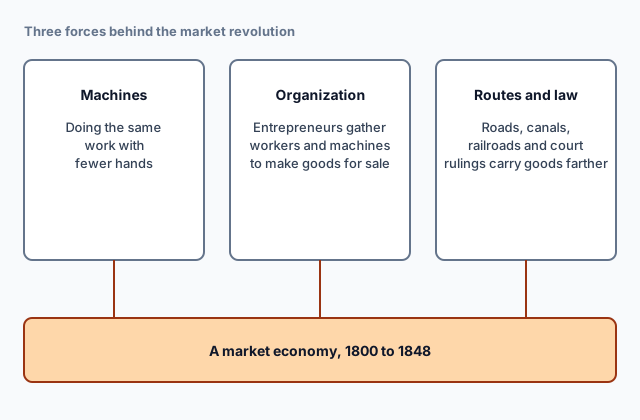
In short. In the market revolution of 1800 to 1848, entrepreneurs, labor-saving machines, and roads, canals and railroads backed by lawmakers and courts made selling to distant buyers the normal way goods changed hands, and Southern cotton bound the South to Northern and English mills.
- Textile machinery, steam engines, interchangeable parts, the telegraph and new farm machines let the same work be done by fewer hands.
- Presidents, Congress and the Supreme Court helped build the routes that carried goods, though federal power to build them was disputed, and those routes tied the North and the Midwest together more closely than they tied the regions of the South.
- Cotton grown by enslaved people fed Northern and English mills, so the regions grew more dependent on each other even as slavery spread.
Part 2 Learn it How the market revolution was built
2a. Machines that do more with fewer hands
An invention makes production more efficient when the same work needs fewer people or less time. Machines that clean cotton had existed for centuries, and Whitney's idea, the National Archives notes, drew on earlier gins and on ideas from others, including Catherine Greene and enslaved laborers. His gin, patented on March 14, 1794, was the first to clean short-staple cotton, and he wrote to his father: "One man and a horse will do more than fifty men with the old machines."
Interchangeable parts were another kind of efficiency: parts made so nearly alike that a broken one could be swapped for a new one, instead of a craftsman shaping each replacement by hand.
The National Archives calls Robert Fulton's 1807 steamboat highly significant; steam moved boats without wind or muscle. On farms, in 1831 Cyrus McCormick improved a horse-drawn machine to harvest wheat, and in 1837 John Deere, a Vermont blacksmith who had moved to Illinois, made a steel plow that cut through prairie soil more efficiently. Textile machinery spun and wove by water or steam power. The telegraph sent messages along a wire, so news of prices and orders could travel far faster than the goods themselves.
Sources: Patent for Cotton Gin (National Archives); Eli Whitney's Patent for the Cotton Gin (National Archives); Gibbons v. Ogden (National Archives). McCormick and Deere are from the AP U.S. History course framework.
Quick check · Match
Match each innovation to the work it made more efficient.
2b. Entrepreneurs and the market
Entrepreneurs, people who put their own money at risk to start a business, organized the making of goods: they gathered machines and workers in one place and sold the output to buyers far away. In a market revolution, that kind of exchange between producers and consumers who never meet becomes the normal way goods change hands.
The course framework points to two examples. In 1789 Samuel Slater, later called the father of American manufactures, wrote to the merchant and manufacturer Moses Brown to propose a business venture. And in Lowell, Massachusetts, on the Merrimack River, textile mills grew into what became known as the Lowell System; in December 1845 a Lowell mill worker, Mary Paul, wrote to her father about her experience there.
Compare two ways to get a coat. A tailor sews one to order for a neighbor he knows, from cloth the neighbor brings. Or a mill weaves cloth by the bolt, a merchant ships it to a town the mill owners have never seen, and a buyer there pays cash for it. The second is a market relationship, and between 1800 and 1848 it came to prevail.
Source: the AP U.S. History course framework, Topic 4.5.
Quick check · Sort it
Tap a card, then the kind of exchange it shows.
Local or household exchange
Market exchange
2c. Roads, canals, railroads and the law
Government helped build the routes goods traveled, though its power to do so was disputed. On March 4, 1817, President James Monroe said in his inaugural address that "the improvement of our country by roads and canals, proceeding always with a constitutional sanction, holds a distinguished place". On March 4, 1825, John Quincy Adams granted that "Some diversity of opinion has prevailed with regard to the powers of Congress for legislation upon objects of this nature." Yet he pointed to a road already in use: "But nearly twenty years have passed since the construction of the first national road was commenced. The authority for its construction was then unquestioned."
New York gave Robert Fulton and Robert Livingston a monopoly on steamboats in the state's waters, though Thomas Gibbons had federal permission to use them. In Gibbons v. Ogden, decided March 2, 1824, the Supreme Court ruled that Congress has the power to regulate commerce among the states and that federal law takes precedence over state laws.
In 1827 what became the Baltimore and Ohio Railroad was chartered in Baltimore, Maryland, to compete with New York City and its ties to the Erie Canal. Such routes linked the North and the Midwest more closely than they linked the regions of the South. The Mississippi still linked New Orleans to the river towns upstream.
Sources: Monroe, Adams (Avalon Project); Gibbons v. Ogden (National Archives); course framework, Topics 4.5 and 4.6.
Quick check · Multiple choice
After Gibbons v. Ogden (1824), which state law would the Court's reasoning most clearly treat as void?
2d. Cotton and the ties between regions
After the gin, the National Archives notes, the yield of raw cotton doubled each decade after 1800. By mid-century the United States was growing three-quarters of the world's supply of cotton, "most of it shipped to England or New England where it was manufactured into cloth," and the South provided three-fifths of the country's exports.
Rising Southern cotton production and the growth of Northern manufacturing, banking and shipping went together. Cotton from the South fed Northern and English mills, and Northern banks and shipping grew with the trade. The result was a web of commercial ties across the nation and across the Atlantic.
The same ties tightened slavery's hold on the South. Cotton growing became so profitable for plantation owners that it greatly increased their demand for both land and enslaved labor. Southern planters depended on Northern and English mill owners to buy their crop, and the mills depended on Southern cotton.
Sources: Patent for Cotton Gin (National Archives); the course framework, Topic 4.5.
Quick check · Fill the statement
Complete the notes on how cotton connected the regions by mid-century.
Cotton grown by enslaved people in the was shipped mostly to mills in New England and . As the cotton trade grew, so did Northern manufacturing, and shipping.
Part 3 Watch it done Back a claim with evidence
Watch each step, then do the last one yourself.
Claim: Government action, and not invention alone, widened the market for transportation in the 1810s and 1820s. Choose the evidence that best supports the claim and explain how it supports it.
Predict first
Before the steps, what kind of evidence do you think this claim needs?
Step 1 · Break the claim into its parts
The claim grants that invention mattered. What it argues is that government action widened the market. Evidence has to prove that second part, so it has to show government doing something that changed where goods or people could go.
Why this step?
Why split the claim before looking for evidence?
Evidence supports a claim only when it matches the part being argued. Naming that part first keeps you from citing something true that proves the part nobody disputes.
Step 2 · Describe each candidate specifically
Monroe, in his first inaugural address in 1817, said roads and canals hold "a distinguished place," "proceeding always with a constitutional sanction." The Gibbons v. Ogden decree of 1824 declared void New York's law keeping federally licensed steamboats off its waters.
Your step · Decide and justify
Finish it. Which evidence better supports the claim that government action widened the market for transportation?
Which explanation shows how it supports the claim?
Part 4 Try it Evidence for an argument about cotton
A student is arguing this claim: The market revolution made the North and the South depend on each other, but transportation did not tie them together the way it tied the North and the Midwest. The evidence has to fit the part of the claim it is used for.
Try it · Multiple choice
Which piece of evidence most directly supports the first part of the claim, that the North and the South depended on each other?
Try it · Spot the error
The student writes a paragraph for the claim. Which line is the first to go wrong?
Part 5 Explain it Write it like a document-based answer
Nothing you type leaves this page. Check your answer against the model and each scoring point.
Free-response practice · Question 1 style
A short practice in the shape of the document-based question: three documents instead of seven, and a thesis with one body paragraph instead of a full essay.
Evaluate the relative importance of government action and private invention in expanding American markets between 1800 and 1848.
Document 1. James Monroe, inaugural address, March 4, 1817: "the improvement of our country by roads and canals, proceeding always with a constitutional sanction, holds a distinguished place." And: "Our manufacturers will likewise require the systematic and fostering care of the Government."
Document 2. Decree of the Supreme Court in Gibbons v. Ogden, March 2, 1824: "so much of the several laws of the state of New York as prohibits vessels, licensed according to the laws of the United States, from navigating the waters of the state of New York, by means of fire or steam, is repugnant to the said Constitution and void." (Repugnant here means in conflict with.)
Document 3. Eli Whitney, in a letter to his father about his improved cotton gin, patented in 1794: "One man and a horse will do more than fifty men with the old machines."
Write a thesis, one sentence of historical context, and one paragraph that uses at least two documents and explains the purpose, audience, point of view or situation of one of them.
Model answer
Thesis: Private invention made goods cheaper and faster to produce, but government action did more to expand markets, because laws, roads and court rulings decided how far those goods could travel.
Context: in the early nineteenth century many Americans moved west of the Appalachians, and farms and workshops there needed ways to reach buyers far away.
Whitney claimed his gin let "One man and a horse" do more than fifty men (Document 3). He was promoting his own machine, and in the same letter he wrote "Tis generally said by those who know anything about it, that I shall make a Fortune by it," so the boast needs checking against other evidence, such as the National Archives' account of cotton output rising after the gin. But output only becomes a market when it can be sold far away. In 1817 Monroe gave roads and canals "a distinguished place" (Document 1). As an inaugural address, it set out a new president's goals before the whole country, and he hedged them, "proceeding always with a constitutional sanction," a sign that federal power to build them was disputed. It shows intention, not results. The Supreme Court then voided New York's steamboat monopoly for vessels licensed under federal law (Document 2), so steamboats could carry trade across state lines. Invention raised what could be made; government widened where it could be sold.
Score your own answer. This is a self-check, not a grade. Tick each point your answer makes.
Part 6 Check yourself What cotton shows
The case questions use the figures in the table. The others mix the ideas from the whole lesson.
The figures below are from the National Archives' account of the cotton gin and its effects. Source: Patent for Cotton Gin (National Archives).
| Measure | What the National Archives reports |
|---|---|
| Yield of raw cotton after the gin | Doubled each decade after 1800 |
| U.S. share of the world's cotton supply, mid-century | Three-quarters |
| Where most U.S. cotton went, mid-century | Shipped to England or New England to be made into cloth |
| South's share of U.S. exports, mid-century | Three-fifths |
Case question 1 · Multiple choice
Which conclusion do the figures in the table best support?
Case question 2 · Multiple choice
Which development in the North is most directly connected to the trend in the table?
The rest stand on their own and do not use the case.
Check yourself · Put it in order
Put these events in the order they happened, earliest first.
Check yourself · Select all
Which two are examples of lawmakers or courts supporting transportation? Select two.
Select 2 answers, then check.
Part 7 Keep it Bring back earlier ideas
This lesson stands on the debates over the American System from Topic 4.3 and the weak central government of the Articles of Confederation from Topic 3.7.
Bring it back · Multiple choice
In the 1820s a member of Congress backs the American System: tariffs to protect manufacturing and federal money for roads and canals. Which objection to such plans fits the debates of the time?
Bring it back · Fill the statement
Read the situation, then complete the sentences.
Suppose that in the 1780s one state taxes goods carried in from a neighboring state, and Congress under the Articles of Confederation can do nothing to stop it. That shows a central government with power. Difficulties like this one, over trade between the states, led many to call for a central government.
In three lines
- Labor-saving machines, from the cotton gin to the reaper, raised what fewer hands could produce.
- Entrepreneurs made production for distant buyers normal, and presidents, Congress and the courts backed the roads, canals and railroads that carried it.
- Southern cotton fed Northern and English mills, tying the regions together while slavery spread.
Exam strategy for this topic
- Section I Part A, Multiple Choice: 55 questions in 55 minutes.
- Section I Part B, Short Answer: 3 questions in 40 minutes.
- Section II, Document-Based Question and Long Essay: 2 questions in 100 minutes.
- This lesson's Explain it is shaped like free-response question 1, Document-based.
When you use a piece of evidence, describe it specifically (who, what, when), then write one sentence saying how it proves the part of your claim that is actually in dispute.
Questions students ask
Why does a lesson on industry spend so much time on cotton?
Southern cotton was the raw material of Northern and English textile mills. Cotton production and Northern manufacturing, banking and shipping grew together, which is how the market revolution tied the regions to each other.
What did Gibbons v. Ogden decide?
On March 2, 1824, the Supreme Court under Chief Justice John Marshall declared void the part of New York's law that kept steamboats licensed under federal law off the state's waters. It held that Congress regulates commerce among the states and that federal law takes precedence over state law.
Did government build all the roads and canals?
No. Lawmakers and courts supported them in different ways: presidents called for them, Congress began a national road, projects such as the Baltimore and Ohio Railroad were chartered, and courts settled who could use the waterways. Federal power to build them was disputed, as Monroe and Adams both acknowledged.
Did Eli Whitney invent the cotton gin?
He improved it. The National Archives notes that machines for removing cotton seeds had existed for centuries, that Whitney's was the first to clean short-staple cotton, and that his idea drew on earlier gins and on others, including Catherine Greene and enslaved laborers.
Course alignment, for teachers
AP U.S. History topic 4.5, Unit 4: Period 4: 1800–1848.
- Skill 6.B: Support an argument using specific and relevant evidence.
This lesson maps all 4 essential knowledge statements of the topic, and the one learning objective with none of its own, to the part that teaches each one: 5 are checked by a scored question. The map is in the lesson file.