Unit 2 · Topic 2.1 · about 30 minutes · 7 parts · 12 scored checks, 4 of them multiple choice
AP U.S. History 2.1: Contextualizing Period 2
Unit 2: 6 to 8% of the multiple-choice section
What you'll be able to do
- Explain the context for the colonization of North America from 1607 to 1754, and describe the historical context of a specific development of the period.
Key vocabulary
| Term | What it means | The exam trap |
|---|---|---|
| Historical context | The larger developments and processes going on around a particular event, document or development. | A true fact from the same years is not context until you show how it bears on the development. |
| Colonial charter | A written grant from a monarch or government giving a person or company the right to found and govern a colony. | A charter states what its authors hoped for; it does not prove the colony turned out that way. |
| Imperial goals | What an empire wanted from its colonies, such as precious metals, furs, land to farm or converts to its faith. | An empire could have more than one goal at once, so name the one a document actually shows. |
| Atlantic slave trade | The forced transport of enslaved Africans across the Atlantic to the Americas, in which several European empires took part. | The trade and a colony's system of slavery are different things; keep them apart in your writing. |
 Tap to open the picture full size
Part 1 Think first Gold in one charter, beaver skins in another
Commit to a guess first. Being wrong now makes the right idea stick better.
Predict first
In 1606 King James's charter for Virginia allowed its colonists to "dig, mine, and search for all Manner of Mines of Gold, Silver, and Copper." In 1626 a Dutch official in Amsterdam reported that a ship from New Netherland had arrived carrying "7246 beaver skins, 17886 otter skins" and other goods. Why do you think the two colonies were after such different things?
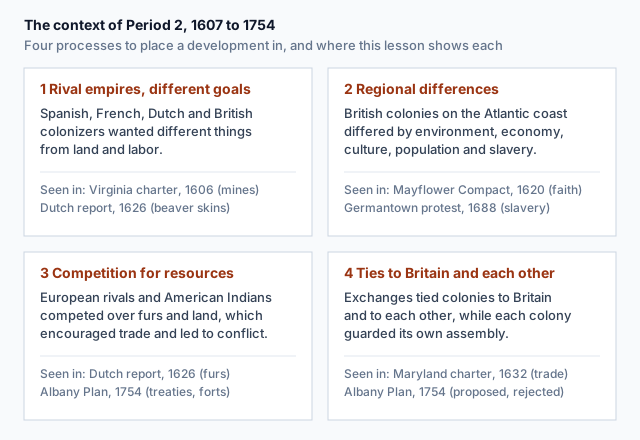
In short. From 1607 to 1754, rival European empires brought different goals to North America, Britain's Atlantic colonies grew apart by region, competition for resources produced both trade and conflict, and the British colonies grew more tied to Britain and to one another.
- Spanish, French, Dutch and British colonizers had different goals for land and labor, and those goals shaped their colonies and their relations with American Indians.
- Competition over resources among European rivals and American Indians encouraged industry and trade and led to conflict.
- Exchanges with Britain drew the colonies closer to Britain and to each other while also encouraging resistance to British control, and the English colonies built a system of slavery shaped by their own economies, populations and geography.
Part 2 Learn it The big picture of Period 2
2a. Rival empires with different goals
Historical context is the set of larger developments around a particular event or document. Placing a development in it is called contextualization, and for colonial North America from 1607 to 1754 the first large development is this: Spanish, French, Dutch and British colonizers came with different economic and imperial goals involving land and labor. Those goals shaped how each colony's society and politics developed, and how each colony dealt with the native peoples around it.
The goals show in the founding papers. England's 1606 charter for Virginia granted land, hoped for mines and named a religious aim. It claimed only land "not now actually possessed by any Christian Prince or People," a reminder that rival Christian empires were already in the Americas. It also counted only Christian rulers as owners, so land held by native peoples was treated as open to claim. The Dutch report of 1626 is about furs and a purchase from the Indians, not mines.
Europeans also settled very different North American environments, and they competed with each other and with American Indians for resources. Topic 2.2 compares the empires one by one.
Sources: First Charter of Virginia, 1606 (Avalon Project); Notification of the Purchase of Manhattan, 1626 (Avalon Project).
Quick check · Multiple choice
Which statement best describes the broad context for European colonization of North America from 1607 to 1754?
2b. British colonies that did not look alike
In the 17th century the early British colonies grew up along the Atlantic coast, and they did not all look alike. Four kinds of factors made the regions differ: environmental (land, soil and climate), economic (how people made a living), cultural (including religion) and demographic (who came, and how many).
Compare two founding documents. The 1606 Virginia charter went to a company of "Knights, Gentlemen, Merchants, and other Adventurers," and it let them search for gold. On November 11, 1620, at Cape Cod, the settlers of New Plymouth signed the Mayflower Compact. They had sailed "for the Glory of God, and Advancement of the Christian Faith," and they agreed to "covenant and combine ourselves together into a civil Body Politick" (spelling as printed).
The same factors shaped slavery. Like other European empires in the Americas that took part in the Atlantic slave trade, the English colonies developed a system of slavery, and its shape reflected each colony's economy, population and geography. It reached even Pennsylvania. In 1688 settlers at Germantown (Avalon titles them Mennonites) wrote to a Quaker monthly meeting against "the traffic of men-body" and against "separating wives from their husbands, and giving them to others." Topic 2.6 follows slavery region by region.
Sources: First Charter of Virginia, 1606 (Avalon Project); Mayflower Compact, 1620 (Avalon Project); Resolutions of the Germantown Mennonites, 1688 (Avalon Project).
Quick check · Sort it
Each card names something that could make one British colony differ from another. Tap a card, then the kind of factor it is.
Environmental
Economic
Cultural
Demographic
2c. Competition, trade and conflict
Across the period, European rivals and American Indians competed over resources such as furs and land. The course framework says that competition did two things: it encouraged industry and trade, and it led to conflict.
The Dutch report of 1626 shows the trade side, as the Dutch told it. The ship's cargo began with "7246 beaver skins, 17886 otter skins," and the report adds: "They have purchased the island Manhattes from the Indians for the value of 60 guilders."
By 1754 the conflict side was plain in a plan to unite the British colonies, the Albany Plan of Union. It would give a general government the power to "hold or direct all Indian treaties," to "make peace or declare war with Indian nations," and to "raise and pay soldiers and build forts." Colonies that needed joint treaties, soldiers and forts were colonies living with rivals.
Sources: Notification of the Purchase of Manhattan, 1626 (Avalon Project); Albany Plan of Union, 1754 (Avalon Project).
Quick check · Fill the statement
Read the situation, then complete the sentences.
Suppose French and English traders both want the furs a native nation brings to the coast. Each side offers better goods and builds a trading post closer to the nation's towns. Later each side builds a fort to keep the other out. The trading posts show competition encouraging . The forts show competition leading to .
2d. Ties to Britain and to each other
The British colonies took part in commercial, religious, philosophical and political exchanges with Britain. Over the period those exchanges tied colonists more closely to Britain and to one another. The course framework adds that they also encouraged resistance to Britain's control, which later topics take up.
Trade was one tie. Maryland's 1632 charter let its colonists carry the "Fruits and Commodities of the said Province" "into any the Ports whatsoever of Us, our Heirs and Successors, of England or Ireland." Religion was another. Pennsylvania's 1681 charter said that if twenty inhabitants asked "the Bishop of London" for a preacher, one "to be approved of by the said Bishop" could be sent to them.
By 1754 some colonists imagined one government for all the colonies. The Albany Congress, called, in the National Archives' words, to unite the colonies during the French and Indian War, adopted a plan to ask for "an act of Parliament of Great Britain" so that "one general government may be formed in America, including all the said colonies." The plan went no further: "the colonial assemblies rejected it because it encroached on their powers." The colonies were drawing closer, inside the empire, but each still guarded its own assembly, even against a union of colonies.
Sources: Charter of Maryland, 1632 (Avalon Project); Charter for the Province of Pennsylvania, 1681 (Avalon Project); Albany Plan of Union, 1754 (Avalon Project); The Founding Fathers: Pennsylvania (National Archives).
Quick check · Match
Match each passage, from the Virginia charter (1606), the Albany Plan (1754) or the National Archives' account of that plan, to what it shows about the colonies.
Part 3 Watch it done Place the Albany Plan in its context
Watch each step, then do the last one yourself.
The Albany Plan of Union (1754) proposed that "one general government may be formed in America, including all the said colonies," with power to "hold or direct all Indian treaties" and to "raise and pay soldiers and build forts." Describe a historical context for the plan.
Predict first
Before the steps, where do you think the plan's context is found?
Step 1 · Say exactly what the development is
A proposal, made under British authority, for one government over the colonies, with power over Indian treaties, Indian trade, land purchases, soldiers and forts.
Why this step?
Why pin down what the plan does before looking for its context?
Context has to fit the development. Once you see that the plan is about joint dealings with American Indians and joint defense, you know which larger processes to look for.
Step 2 · Find the larger processes it belongs to
Ask what had been going on across the colonies, for many years, that would make joint treaties, soldiers and forts seem necessary. The answer has to be a process of the whole period, not a clause of the plan.
Your step · Decide and justify
Finish it. Which sentence best describes a historical context for the Albany Plan?
Which evidence from the plan best supports your answer?
Part 4 Try it Context for a Dutch charter
Now judge someone else's context. The States-General of the United Netherlands chartered the Dutch West India Company on June 3, 1621. The charter put "navigation, trade, and commerce" at its center, and it let the company "make contracts, engagements and alliances with the princes and natives of the countries comprehended therein, and also build any forts and fortifications there."
Source: Charter of the Dutch West India Company, 1621 (Avalon Project).
Try it · Spot the error
A student writes a context paragraph for the 1621 charter. Which line is the first to go wrong?
Part 5 Explain it Write it like a document-based answer
Nothing you type leaves this page. Check your answer against the model and each scoring point.
Free-response practice · Question 1 style
A short practice in the shape of the document-based question: three documents instead of seven, and a thesis with one body paragraph instead of a full essay.
Evaluate the extent to which British colonists became more closely tied to Britain and to one another between 1606 and 1754.
Document 1. The First Charter of Virginia, granted by King James, April 10, 1606: "each of the said Colonies shall have a Council" to govern it "according to such Laws, Ordinances, and Instructions, as shall be, in that behalf, given and signed with Our Hand or Sign Manual." The colonists are to have "all Liberties, Franchises, and Immunities" of the king's subjects, "as if they had been abiding and born, within this our Realm of England."
Document 2. The Mayflower Compact, signed by the settlers of New Plymouth, November 11, 1620: the signers call themselves the "Loyal Subjects of our dread Sovereign Lord King James" and agree to "covenant and combine ourselves together into a civil Body Politick" (spelling as printed) "for our better Ordering and Preservation," to make "such just and equal Laws, Ordinances, Acts, Constitutions, and Officers" as they need.
Document 3. The Albany Plan of Union, 1754: "one general government may be formed in America, including all the said colonies, within and under which government each colony may retain its present constitution." Its laws "shall be transmitted to the King in Council for approbation."
Write a thesis, one sentence of historical context, and one paragraph that uses at least two documents and explains the purpose, audience, point of view or situation of one of them.
Model answer
Thesis: Between 1606 and 1754 the colonists stayed loyal subjects of the crown, and trade gave them more ties to Britain, while their ties to one another grew only part of the way: by 1754 colonial leaders could imagine a common government, but the colonies would not yet give one power over them.
Context: rival empires and American Indians competed with the British colonies for land and trade throughout the period, and when war with France came in the 1750s, colonists had new reason to think about acting together.
In 1606 the colonies were to be governed by councils working under laws and instructions "signed with Our Hand" (Document 1), arrangements made in England by the king. The Plymouth settlers of 1620 made their own "civil Body Politick" (Document 2) and wrote it for their own "better Ordering and Preservation." They signed it at Cape Cod, before their colony existed, and even there, making their own laws, they framed themselves as the king's "Loyal Subjects," which shows how natural the tie to the crown was to a self-governing group. Outside these documents, trade added ties: Maryland's 1632 charter let colonists ship their goods into English ports. By 1754 the Albany Plan imagined "one general government" for "all the said colonies" (Document 3), with its laws sent to "the King in Council," so union was pictured inside the empire, not against it. Yet the plan was only a proposal. The colonial assemblies rejected it to protect their own powers, so ties among the colonies were still limited.
Score your own answer. This is a self-check, not a grade. Tick each point your answer makes.
Part 6 Check yourself One charter, one plan of union
The case questions use the two excerpts. The others mix the ideas from the whole lesson.
The first excerpt is from King James's charter for Virginia; the second is from a plan for uniting the British colonies a century and a half later. Sources: First Charter of Virginia, 1606 (Avalon Project); Albany Plan of Union, 1754 (Avalon Project).
| Document | Excerpt |
|---|---|
| The First Charter of Virginia, April 10, 1606 | "each of the said Colonies shall have a Council" to govern it "according to such Laws, Ordinances, and Instructions, as shall be, in that behalf, given and signed with Our Hand or Sign Manual" |
| Albany Plan of Union, 1754 | "one general government may be formed in America, including all the said colonies, within and under which government each colony may retain its present constitution" |
Case question 1 · Multiple choice
Which change from 1606 to 1754 do the two excerpts best show?
Case question 2 · Multiple choice
The same 1754 plan would let its general government "hold or direct all Indian treaties" and "raise and pay soldiers and build forts." Which context best explains those powers?
The rest stand on their own and do not use the case.
Check yourself · Put it in order
Put these documents in the order they were written, earliest first. The Mayflower Compact was signed six years before the Manhattan report.
Check yourself · Select all
In one colony, tobacco sells well in England, planters keep adding land, and the servants who once worked the fields finish their terms and leave to farm for themselves. Which two statements best explain why slavery grew large there? Select two.
Select 2 answers, then check.
Part 7 Keep it Bring back Period 1
Period 2 grows out of Period 1: the Spanish conquest of Topic 1.4 and the encounters of Topic 1.6.
Bring it back · Multiple choice
Which development most furthered the Spanish conquest of the Americas in the 1500s?
Bring it back · Fill the statement
Read the situation, then complete the sentences.
Suppose settlers keep moving onto a native nation's hunting grounds and demanding its people's labor. The nation first sends speakers to the colony's governor to agree on where the boundary should run. When that fails, it takes up arms against the settlements. The speakers' mission is an example of . Taking up arms is an example of .
In three lines
- Rival European empires brought different goals for land and labor to the varied environments of North America.
- Britain's Atlantic colonies differed by region, and competition over resources produced both trade and conflict.
- Exchanges with Britain tied the colonies to Britain and to each other while encouraging resistance, and the English colonies built a system of slavery of their own.
Exam strategy for this topic
- Section I Part A, Multiple Choice: 55 questions in 55 minutes.
- Section I Part B, Short Answer: 3 questions in 40 minutes.
- Section II, Document-Based Question and Long Essay: 2 questions in 100 minutes.
- This lesson's Explain it is shaped like free-response question 1, Document-based.
When a question asks for historical context, name a broader process of the period, such as rivalry among empires or growing ties to Britain, and say in the same sentence how it bears on the development in the question.
Questions students ask
What years does Period 2 cover?
The course framework's Period 2 runs from 1607 to 1754. This lesson's earliest document, the Virginia charter of 1606, was granted the year before the period begins.
Did the Albany Plan unite the colonies?
No. The Albany Congress adopted it in 1754, but the National Archives notes that the colonial assemblies rejected it because it encroached on their powers. It shows colonial leaders imagining union, not the colonies achieving it.
Is context the same as background?
Close, but context has a job. It names a larger process and shows how that process bears on the development you are writing about. Background that never connects to the development does not do that job.
Why does a quotation in this lesson spell politic as "Politick"?
Every excerpt is copied exactly as the archive prints it, so you can check it against the source linked beside it.
Why does this lesson lean on charters and plans?
Founding documents state what colonizers wanted and how they meant to govern, which is the context this topic is about. Remember that they show intentions, not results.
Where can I read these documents in full?
Each excerpt links to its full text at the Avalon Project at Yale Law School, the primary-source collection this lesson was checked against.
Course alignment, for teachers
AP U.S. History topic 2.1, Unit 2: Period 2: 1607–1754.
- Skill 4.A: Identify and describe a historical context for a specific historical development or process.
This lesson maps all 7 essential knowledge statements of the topic, and the one learning objective with none of its own, to the part that teaches each one: 8 are checked by a scored question. The map is in the lesson file.