Unit 9 · Topic 9.3 · about 30 minutes · 7 parts · 13 scored checks, 5 of them multiple choice
AP U.S. History 9.3: The End of the Cold War
Unit 9: 4 to 6% of the multiple-choice section
What you'll be able to do
- Explain the causes and effects of the end of the Cold War and its legacy.
Key vocabulary
| Term | What it means | The exam trap |
|---|---|---|
| Totalitarian | Describes a state that tries to control every part of its people's lives, from politics to work to belief. | Totalitarian describes how far a government's control reaches, not simply that the government is strict. |
| Mutual assured destruction | The nuclear standoff in which each side is kept from striking first by the certainty that it would be destroyed in return. | It names a standoff of threats meant to stop either side from striking first, not a goal either side pursued. |
| Arms reduction | Cutting the number of weapons each side holds, as Reagan said in 1985 he sought for nuclear weapons. | Reducing weapons is more than limiting new ones; a freeze stops growth but cuts nothing. |
| Peacekeeping intervention | Sending forces abroad to keep order or keep warring sides apart, rather than to defeat an enemy. | The course framework names peacekeeping beside military interventions, so do not treat the two as the same. |
 Tap to open the picture full size
Part 1 Think first Strength or talks?
Commit to a guess first. Being wrong now makes the right idea stick better.
Predict first
In January 1985 Ronald Reagan said the Soviet Union "has conducted the greatest military buildup in the history of man, building arsenals of awesome offensive weapons." He also said, "We have made progress in restoring our defense capability. But much remains to be done." In the same speech he spoke about talks with the Soviets. What do you think he said he wanted from those talks?
In short. Reagan opposed communism with speeches, diplomacy, limited military interventions and a buildup of nuclear and conventional weapons, and the course framework counts increased U.S. military spending, Reagan's diplomatic initiatives, and political changes and economic problems in Eastern Europe and the Soviet Union as all important in ending the Cold War, which left new diplomatic relationships, new interventions and new debates about American power.
- Reagan paired rebuilt defenses with talks: in 1985 he said of nuclear weapons, "We seek, instead, to reduce their number."
- The Cold War's end had several causes, and the course framework treats U.S. military spending, Reagan's diplomacy, and change inside Eastern Europe and the Soviet Union as all important.
- Afterward the United States built new diplomatic relationships, sent forces on new military and peacekeeping missions, and kept debating how to use its power.
Part 2 Learn it How the Cold War ended, and what came after
2a. Opposing communism with strength and words
The AP U.S. History course framework says Reagan asserted U.S. opposition to communism through speeches, diplomatic efforts, limited military interventions, and a buildup of nuclear and conventional weapons. His inaugural addresses show the speeches and the buildup; they do not describe the limited interventions.
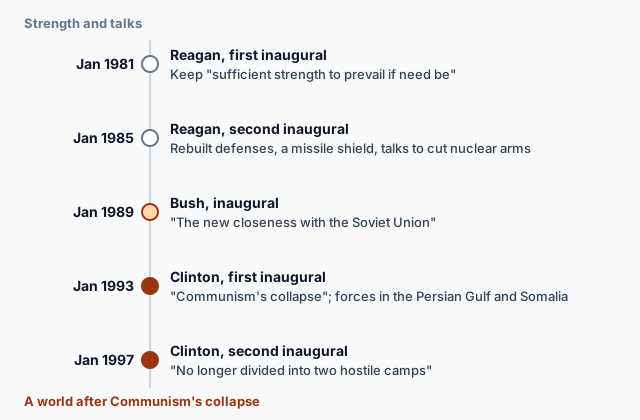
In January 1981 he turned to "the enemies of freedom, those who are potential adversaries," and said they would be reminded that peace was what Americans wanted most: "We will negotiate for it, sacrifice for it; we will not surrender for it." Then he added: "We will maintain sufficient strength to prevail if need be, knowing that if we do so we have the best chance of never having to use that strength."
In January 1985 he said the Soviet Union "has conducted the greatest military buildup in the history of man, building arsenals of awesome offensive weapons," and that "We have made progress in restoring our defense capability. But much remains to be done." He predicted his first term would be remembered for "sincere efforts at meaningful arms reduction, rebuilding our defenses," and as years when Americans "turned the tide of history away from totalitarian darkness and into the warm sunlight of human freedom." A totalitarian state tries to control every part of its people's lives.
Sources: Reagan, First Inaugural, 1981 (Avalon Project); Reagan, Second Inaugural, 1985 (Avalon Project).
Quick check · Sort it
Each card is a line from one of Reagan's inaugural addresses. Tap a card, then the policy it describes.
Building military strength
Seeking peace through talks
2b. A security shield and arms talks
Reagan's 1985 address turned to the Soviet Union with talks first: "We are not just discussing limits on a further increase of nuclear weapons. We seek, instead, to reduce their number."
Then he described the nuclear standoff: "for decades, we and the Soviets have lived under the threat of mutual assured destruction; if either resorted to the use of nuclear weapons, the other could retaliate and destroy the one who had started it." Mutual assured destruction is that standoff: each side is kept from striking first by the certainty that it would be destroyed in return. He asked: "Is there either logic or morality in believing that if one side threatens to kill tens of millions of our people, our only recourse is to threaten killing tens of millions of theirs?"
His next words were a research program: "I have approved a research program to find, if we can, a security shield that would destroy nuclear missiles before they reach their target." He said it "wouldn't kill people, it would destroy weapons" and said it would make nuclear weapons obsolete. Right after, he returned to talks: "We will meet with the Soviets, hoping that we can agree on a way to rid the world of the threat of nuclear destruction."
These are Reagan's own claims to the American public. They state goals, not results.
Quick check · Multiple choice
Reagan said in 1985: "I have approved a research program to find, if we can, a security shield that would destroy nuclear missiles before they reach their target." He presented the shield as a way out of which problem?
2c. Why did the Cold War end?
The course framework names three causes and counts all of them as important: increased U.S. military spending, Reagan's diplomatic initiatives, and political changes and economic problems in Eastern Europe and the Soviet Union.
No primary source in this lesson shows the Soviet side. Every document here is an American president's inaugural address, so the third cause appears only in the course framework's words and in how American presidents described the change from outside. In January 1989 George Bush, Reagan's vice president, took office and said "a new breeze is blowing, and a world refreshed by freedom seems reborn; for in man's heart, if not in fact, the day of the dictator is over." He went on: "The totalitarian era is passing, its old ideas blown away like leaves from an ancient, lifeless tree." Note "if not in fact": he described a hope more than a finished change. By January 1993 William J. Clinton could say: "Communism's collapse has called forth old animosities and new dangers."
Neither speech names a country, an event or a date inside Eastern Europe or the Soviet Union, and neither describes economic problems there. A historian needs other sources for that side. Bush also hedged his own view of the new relationship: "One might say that our new relationship in part reflects the triumph of hope and strength over experience."
Sources: Bush, Inaugural, 1989 (Avalon Project); Clinton, First Inaugural, 1993 (Avalon Project).
Quick check · Match
Match each piece of evidence to what it shows about the end of the Cold War.
2d. After the Cold War
The course framework says the end of the Cold War led to new diplomatic relationships, but also to new U.S. military and peacekeeping interventions, and to continued debates over the appropriate use of American power in the world.
In January 1997 Clinton, beginning his second term, said: "The world is no longer divided into two hostile camps. Instead, now we are building bonds with nations that once were our adversaries." In 1993 he had named Americans serving in the Persian Gulf and Somalia, as you will read below; the speeches do not describe those missions, so this lesson does not say which were military and which peacekeeping.
The debate over power went on. In 2001 George W. Bush said "America remains engaged in the world by history and by choice, shaping a balance of power that favors freedom," and promised "we will show purpose without arrogance." In 2009 Barack Obama said "we are ready to lead once more," and that earlier generations understood "our power alone cannot protect us, nor does it entitle us to do as we please." Bush's lines put more weight on what American power can shape, and Obama's more on its limits, though each spoke to both. The course framework calls these continued debates and does not settle them.
Sources: Clinton, Second Inaugural, 1997 (Avalon Project); G. W. Bush, Inaugural, 2001 (Avalon Project); Obama, Inaugural, 2009 (Avalon Project).
Quick check · Fill the statement
Complete the notes on what followed the end of the Cold War.
In 1997 Clinton said the United States was "building bonds with nations that once were our adversaries," an example of . The course framework also names new U.S. military and interventions, and continued over the appropriate use of American power.
Part 3 Watch it done Explain the new closeness of 1989
Watch each step, then do the last one yourself.
On January 20, 1989, George Bush promised to "continue the new closeness with the Soviet Union." Explain how developments of the 1980s connect to that new relationship, and what these speeches can and cannot show about it.
Step 1 · Name the change
In 1985 Reagan said the Soviet Union had built "arsenals of awesome offensive weapons." Four years later Bush spoke of a new closeness with the Soviet Union. Relations had changed between the two speeches.
Why this step?
Why name the change before looking for causes?
A cause explains a change. If you cannot say what was different afterward, you cannot test whether a cause fits it.
Step 2 · Find the causes in the evidence
Reagan's 1985 address joins rebuilt defenses with talks to reduce nuclear weapons. Those are two of the causes the course framework names. Now ask what the speeches leave out.
Your step · Decide and justify
Finish it. What can a historian conclude about the causes of the new closeness from this lesson's speeches?
Which evidence best supports your answer?
Part 4 Try it The world after, in 1993
On January 20, 1993, William J. Clinton took office after George Bush. Early in the address he thanked the Americans "whose steadfastness and sacrifice triumphed over Depression, fascism and Communism." Later he turned to the world:
"Today, as an old order passes, the new world is more free but less stable. Communism's collapse has called forth old animosities and new dangers. Clearly America must continue to lead the world we did so much to make."
He promised to act "with peaceful diplomacy when ever possible, with force when necessary" (spelling as printed), and said: "The brave Americans serving our nation today in the Persian Gulf, in Somalia, and wherever else they stand are testament to our resolve."
Try it · Multiple choice
Which effect of the Cold War's end does Clinton's 1993 passage most directly describe?
Try it · Spot the error
A student explains Clinton's 1993 view of the world after the Cold War. Which line is the first to go wrong?
Part 5 Explain it Write it like a document-based answer
Nothing you type leaves this page. Check your answer against the model and each scoring point.
Free-response practice · Question 1 style
A short practice in the shape of the document-based question: three documents instead of seven, and a thesis with one body paragraph instead of a full essay.
Evaluate the extent to which the end of the Cold War changed how American presidents described the nation's role in the world from 1985 to 1993.
Document 1. Ronald Reagan, Second Inaugural Address, January 21, 1985: the Soviet Union "has conducted the greatest military buildup in the history of man, building arsenals of awesome offensive weapons." And: "America must remain freedom's staunchest friend, for freedom is our best ally."
Document 2. George Bush, Inaugural Address, January 20, 1989: "While keeping our alliances and friendships around the world strong, ever strong, we will continue the new closeness with the Soviet Union, consistent both with our security and with progress."
Document 3. William J. Clinton, First Inaugural Address, January 20, 1993: "Today, as an old order passes, the new world is more free but less stable. Communism's collapse has called forth old animosities and new dangers. Clearly America must continue to lead the world we did so much to make."
Write a thesis, one sentence of historical context, and one paragraph that uses at least two documents and explains the purpose, audience, point of view or situation of one of them.
Model answer
Thesis: From 1985 to 1993 presidents changed how they described the threats America faced, from one heavily armed Soviet rival to scattered new dangers after Communism's collapse, but they kept describing the United States as the leader and defender of freedom in the world.
Context: since the years after 1945 the United States had sought to contain Communist power and influence, and the Cold War had swung between periods of confrontation and periods of mutual coexistence, or détente.
In 1985 Reagan named a single rival: the Soviet Union, which he said "has conducted the greatest military buildup in the history of man" (Document 1). By 1989 Bush promised "the new closeness with the Soviet Union" (Document 2), though still "consistent both with our security and with progress." Bush spoke to the American public at his inauguration, and the same passage of his speech opens "We will stay strong to protect the peace," so his closeness comes paired with a promise of strength to reassure Americans; it shows how he wanted the change understood at home, not how Soviet leaders saw it. In 1993 Clinton said "the new world is more free but less stable" and that "Communism's collapse has called forth old animosities and new dangers" (Document 3). The threat had changed from one rival to many dangers. The role did not: Reagan called America "freedom's staunchest friend," and Clinton said "America must continue to lead the world we did so much to make."
Score your own answer. This is a self-check, not a grade. Tick each point your answer makes.
Part 6 Check yourself Two speeches, twelve years apart
The case questions use the two excerpts. The others mix the ideas from the whole lesson.
Both excerpts come from inaugural addresses. Sources: Reagan, Second Inaugural, 1985 (Avalon Project); Clinton, Second Inaugural, 1997 (Avalon Project).
| Document | Excerpt |
|---|---|
| Ronald Reagan, Second Inaugural Address, January 21, 1985 | "for decades, we and the Soviets have lived under the threat of mutual assured destruction; if either resorted to the use of nuclear weapons, the other could retaliate and destroy the one who had started it." |
| William J. Clinton, Second Inaugural Address, January 20, 1997 | "The world is no longer divided into two hostile camps. Instead, now we are building bonds with nations that once were our adversaries." |
Case question 1 · Multiple choice
Which development best explains the difference between the two excerpts?
Case question 2 · Multiple choice
Between the two excerpts, the Cold War ended. Besides Reagan's diplomatic initiatives and increased U.S. military spending, which development does the course framework count as important in ending it?
The rest stand on their own and do not use the case.
Check yourself · Put it in order
Put these statements from inaugural addresses in the order they were made, earliest first.
Check yourself · Select all
Which two does the course framework name among the ways Reagan asserted U.S. opposition to communism? Select two.
Select 2 answers, then check.
Part 7 Keep it Bring back earlier ideas
This lesson stands on Reagan's conservative program from Topic 9.2 and the Cold War of 1945 to 1980 from Topic 8.2.
Bring it back · Multiple choice
Which policies does the course framework say Reagan's victory in the 1980 election allowed conservatives to enact?
Bring it back · Fill the statement
Complete the sentences.
From 1945 to 1980 the Cold War swung between periods of direct and indirect military and periods of mutual coexistence. Those periods of easing tension are known as .
In three lines
- Reagan opposed communism with speeches, diplomatic efforts, limited military interventions and a buildup of nuclear and conventional weapons, and paired that strength with arms talks.
- Increased U.S. military spending, Reagan's diplomatic initiatives, and political changes and economic problems in Eastern Europe and the Soviet Union were all important in ending the Cold War.
- The end of the Cold War brought new diplomatic relationships, new military and peacekeeping interventions, and continued debates over the use of American power.
Exam strategy for this topic
- Section I Part A, Multiple Choice: 55 questions in 55 minutes.
- Section I Part B, Short Answer: 3 questions in 40 minutes.
- Section II, Document-Based Question and Long Essay: 2 questions in 100 minutes.
- This lesson's Explain it is shaped like free-response question 1, Document-based.
When a question asks why the Cold War ended, explain more than one of the causes the course framework names and tie each to evidence, rather than crediting a single person or policy.
Questions students ask
Which cause ended the Cold War?
The course framework does not pick one. It counts increased U.S. military spending, Reagan's diplomatic initiatives, and political changes and economic problems in Eastern Europe and the Soviet Union as all important.
What was the security shield Reagan described?
In his 1985 address Reagan said he had approved research into a shield that would destroy nuclear missiles before they reached their targets, and claimed it would make nuclear weapons obsolete. The speech states his goals; it does not show what the research achieved.
Did the end of the Cold War end American military action abroad?
No. The course framework names new U.S. military and peacekeeping interventions after it, and in 1993 Clinton named Americans then serving in the Persian Gulf and Somalia.
Why does this lesson say so little about events inside the Soviet Union?
Every primary source in this lesson is an American president's inaugural address, and none describes events inside Eastern Europe or the Soviet Union. The lesson gives that cause in the course framework's own words rather than add events or dates it cannot show you a source for.
Why does a quotation in this lesson write whenever as two words?
Every excerpt is copied exactly as the archive prints it, so you can check it against the source linked beside it.
Where can I read these speeches in full?
Each excerpt links to its full text at the Avalon Project at Yale Law School, the primary-source collection this lesson was checked against.
Course alignment, for teachers
AP U.S. History topic 9.3, Unit 9: Period 9: 1980–Present.
- Skill 1.B: Explain a historical concept, development, or process.
This lesson maps all 3 essential knowledge statements of the topic, and the one learning objective with none of its own, to the part that teaches each one: 4 are checked by a scored question. The map is in the lesson file.