Unit 7 · Topic 7.15 · about 30 minutes · 7 parts · 13 scored checks, 3 of them multiple choice
AP U.S. History 7.15: Comparison in Period 7
Unit 7: 10 to 17% of the multiple-choice section
What you'll be able to do
- Compare the relative significance of the major events of the first half of the 20th century in shaping American identity, and corroborate, qualify or modify an argument about them with evidence.
Key vocabulary
| Term | What it means | The exam trap |
|---|---|---|
| Historical significance | How much an event mattered, judged by a standard such as how many people it affected, how deeply and for how long. | Significance needs a stated standard; an event can rank high by one standard and low by another. |
| Corroborate | To support a claim with further evidence, often of a different kind, that points the same way. | Repeating the same piece of evidence is not corroboration. |
| Qualify | To limit a claim by naming where or how far it does not hold, while keeping its core. | A qualification narrows a claim; read whether the evidence narrows it or reverses it. |
| Limited welfare state | A government that provides some protection against economic hardship, such as old-age benefits, without taking over the economy. | Limited is part of the term; it describes how far the protection went. |
| Mass culture | Entertainment and ideas shared by millions at once, spread by radio and film in the 1920s. | Mass culture did not end regional cultures; it also made Americans more aware of them. |
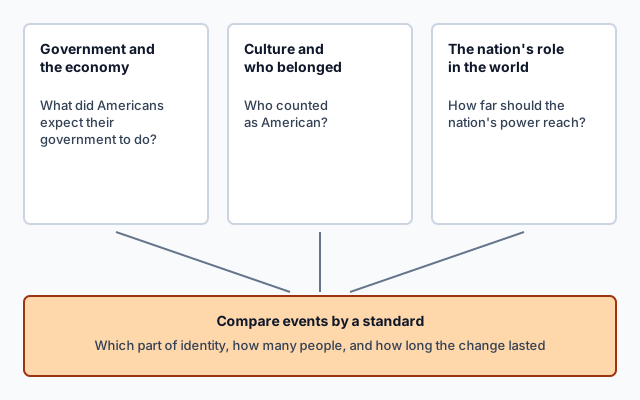 Tap to open the picture full size
Part 1 Think first Which event mattered most?
Commit to a guess first. Being wrong now makes the right idea stick better.
Predict first
Between 1890 and 1945 Americans lived through overseas expansion, Progressive reform, World War I, the 1920s, the Great Depression and World War II. Which do you think did most to change how Americans saw their nation?
In short. Comparing the events of Period 7 means judging which did most to shape how Americans saw their nation, its economy and government, who belonged to it, and its role in the world, by a standard you state and test against evidence.
- Progressive reform and then the New Deal changed what Americans expected the federal government to do, ending in a limited welfare state.
- Mass culture spread through radio and film while migration rose and fell with economic pressures, global events and political decisions such as the quota laws.
- Expansion after 1898 and two world wars renewed the debate over the nation's role in the world, and World War II left the United States a world leader.
Part 2 Learn it Three parts of American identity
2a. Government and the economy
Between 1890 and 1945 the United States kept changing from a rural, agricultural economy to an urban, industrial one led by large companies. Growth widened opportunity, and economic instability led to new efforts to reform the society and the economy.
In the early 1900s Progressives answered political corruption, economic instability and social problems by calling for greater government action. The Keating-Owen Act of 1916, the first federal child labor law, barred goods from mines where "children under the age of sixteen years have been employed or permitted to work." The Supreme Court later ruled it unconstitutional. Progressives also won constitutional amendments: the 17th, ratified in 1913, let voters elect senators directly, and the 19th, ratified on August 18, 1920, says: "The right of citizens of the United States to vote shall not be denied or abridged by the United States or by any State on account of sex."
In the 1930s, policymakers answered the mass unemployment of the Great Depression by making the United States a limited welfare state. Before then, the National Archives notes, support for the elderly had been a local, state and family concern. The Social Security Act of 1935, "An act to provide for the general welfare by establishing a system of Federal old-age benefits," made it a federal one, and modern American liberalism came to mean a government that guards people against hardship.
Sources: Keating-Owen Act (National Archives); 17th Amendment (National Archives); 19th Amendment (National Archives); Social Security Act (National Archives).
Quick check · Match
Match each development of Period 7 to what it changed.
2b. Culture and who belonged
New communications and technology, above all radio and film, spread a mass culture across the country, even as Americans argued over its effects on public values, morals and national identity.
Migration changed sharply in its numbers, its sources and the experiences of migrants, driven by economic pressures, global events and political decisions. Immigration from Europe reached its peak in the years before World War I. During and after the war, nativist campaigns led to quotas that restricted immigration, particularly from southern and eastern Europe, and raised barriers to Asian immigration. In the Great Migration, which the National Archives calls "one of the largest movements of people in United States history," African Americans left the segregation, violence and limited opportunity of the South for the North and West, where they found new opportunities and still met discrimination. War production in both world wars drew Americans to cities, and migration from Mexico and elsewhere in the Western Hemisphere grew in spite of contradictory government policies.
Through all of it, the question of who counted as American stayed open.
Quick check · Fill the statement
Complete the notes on culture and migration.
New media such as spread a national culture, while Americans its effects on morals and national identity. Quotas after World War I restricted immigration from Europe, and in the Great Migration African Americans moved .
2c. The nation's role in the world
Three wars framed a long argument over the nation's role in the world. After the war with Spain in 1898, the United States acquired island territories in the Caribbean and the Pacific, and it annexed Hawaii by joint resolution on July 7, 1898. The new territories set off heated public debate: anti-imperialists argued that a republic should not rule colonies overseas. In December 1904 Theodore Roosevelt told Congress that the United States might be forced to the exercise of "an international police power" in the Western Hemisphere.
World War I deepened the debate. Asking Congress for war on April 2, 1917, Woodrow Wilson said: "The world must be made safe for democracy." After the war the Senate refused to ratify the Treaty of Versailles or join the League of Nations, and in the 1930s most Americans opposed military action against Germany and Japan until Pearl Harbor.
World War II changed the answer. In January 1941 Franklin Roosevelt looked forward to a world founded upon "four essential human freedoms," which, the National Archives notes, symbolized America's war aims. The war transformed American society, and victory lifted the United States into global political and military leadership.
Sources: Annexation of Hawaii (National Archives); Roosevelt Corollary (National Archives); Wilson's war message (National Archives); Four Freedoms (National Archives).
Quick check · Put it in order
Put these events in the order they happened, earliest first.
2d. Comparing significance
To compare how significant events were, set a standard first: significant for which part of identity, for how many people, and for how long. Then make the argument complex. Corroborate a claim with a different kind of evidence that points the same way, qualify it by naming its limits, or modify it when evidence pushes against it.
Take the claim that the New Deal did more than any other event to change what Americans expected of their government. The Social Security Act corroborates it. The Progressive Era qualifies it: a federal child labor law came in 1916, so the call for government action was older than the Depression. The course framework adds evidence that pushes against it: the New Deal did not end the Depression, and wartime mobilization helped end it. That modifies the claim, which might now read: the New Deal changed what Americans expected of government, but the war delivered the recovery.
A strong comparison ends with a judgment: which event mattered more by your standard, and why the others mattered less.
Sources: Social Security Act (National Archives).
Quick check · Decide and justify
A student argues that the 19th Amendment shows Progressive reform changed who took part in American democracy. The National Archives notes that many women remained unable to vote long into the 20th century because of discriminatory state voting laws. What does that evidence do to the student's claim?
Which reason best supports your answer?
Part 3 Watch it done Compare the two world wars
Watch each step, then do the last one yourself.
Asking for war in April 1917, Woodrow Wilson said: "The world must be made safe for democracy." In January 1941 Franklin Roosevelt said: "Freedom means the supremacy of human rights everywhere. Our support goes to those who struggle to gain those rights or keep them." Which war had greater significance for Americans' sense of their nation's role in the world?
Predict first
Before the steps, which war do you think the evidence will favor?
Step 1 · Set the standard
Judge each war by how long the change in the nation's role lasted after the fighting stopped, not by how grand its words were.
Why this step?
Why not compare the speeches themselves?
Both speeches claim a world mission, so the words alone cannot tell the wars apart. What Americans did after each war shows whether the claim held.
Step 2 · Test both wars
For each war, look at what the nation did in the years after the fighting stopped, then compare the two.
Your step · Decide and justify
Finish it. By that standard, which war had greater significance for the nation's role in the world?
Which evidence best supports your answer?
Part 4 Try it Test a claim about the New Deal
A student argues that the New Deal was the most significant event of Period 7 in shaping American identity, because it was the first time Americans asked the federal government to protect them from economic hardship. Test the claim against the evidence from this lesson.
Try it · Multiple choice
Which evidence would best qualify the student's claim?
Try it · Spot the error
A student writes a paragraph comparing events of Period 7. Which line is the first to go wrong?
Part 5 Explain it Write it like a document-based answer
Nothing you type leaves this page. Check your answer against the model and each scoring point.
Free-response practice · Question 1 style
A short practice in the shape of the document-based question: three documents instead of seven, and a thesis with one body paragraph instead of a full essay.
Evaluate the extent to which World War II was more significant than earlier events of 1890 to 1945 in shaping Americans' sense of their nation's role in the world.
Document 1. Theodore Roosevelt, annual message to Congress, December 6, 1904: "in the Western Hemisphere the adherence of the United States to the Monroe Doctrine may force the United States, however reluctantly, in flagrant cases of such wrongdoing or impotence, to the exercise of an international police power."
Document 2. Woodrow Wilson, address to Congress asking for war against Germany, April 2, 1917: "The world must be made safe for democracy." And: "We desire no conquest, no dominion."
Document 3. Franklin Roosevelt, annual message to Congress, January 6, 1941, eleven months before Pearl Harbor: "Freedom means the supremacy of human rights everywhere. Our support goes to those who struggle to gain those rights or keep them."
Write a thesis, one sentence of historical context, and one paragraph that uses at least two documents and explains the purpose, audience, point of view or situation of one of them.
Model answer
Thesis: World War II was more significant than earlier events in shaping Americans' sense of a world role, because it turned a claim the nation had made before into a lasting position of global leadership, though the claim itself had roots in 1898 and 1917.
Context: after the war with Spain in 1898, the United States acquired island territories in the Caribbean and the Pacific, and Americans argued over whether a republic should hold an empire.
In 1904 Theodore Roosevelt claimed "an international police power" (Document 1), but only "in the Western Hemisphere." Wilson widened the claim to the whole world in 1917 (Document 2). Speaking to Congress to win a vote for war, he stressed that the nation sought "no conquest, no dominion," since Americans long wary of European wars had to be persuaded, though the Senate's later refusal to join the League shows the world mission Wilson described did not outlast the war. Roosevelt's promise, made eleven months before the United States entered the war, of support for those who struggle for rights "everywhere" (Document 3) went further still, and after victory the United States hosted the founding of the United Nations. World War II mattered most because its claim lasted.
Score your own answer. This is a self-check, not a grade. Tick each point your answer makes.
Part 6 Check yourself Government and citizens, 1916 to 1941
The case questions use the four excerpts. The others mix the ideas from the whole lesson.
Four documents from a quarter century of change in what Americans asked of their government. Sources: Keating-Owen Act (National Archives); 19th Amendment (National Archives); Social Security Act (National Archives); Four Freedoms (National Archives).
| Document | Excerpt |
|---|---|
| Keating-Owen Act, 1916 | Bars goods from mines in which "children under the age of sixteen years have been employed or permitted to work" |
| 19th Amendment, ratified 1920 | "The right of citizens of the United States to vote shall not be denied or abridged by the United States or by any State on account of sex." |
| Social Security Act, 1935 | "An act to provide for the general welfare by establishing a system of Federal old-age benefits" |
| Franklin Roosevelt, annual message, 1941 | Names among the freedoms all people should have "freedom of speech, freedom of worship, freedom from want, and freedom from fear" (as the National Archives summarizes them) |
Case question 1 · Select all
Which two documents in the table come from the Progressive Era? Select two.
Select 2 answers, then check.
Case question 2 · Multiple choice
Which comparison of the four excerpts is best supported?
The rest stand on their own and do not use the case.
Check yourself · Sort it
Claim: World War II did more than any earlier event to give the United States a world role. Tap each piece of evidence, then say whether it corroborates the claim or qualifies it.
Corroborates
Qualifies
Check yourself · Fill the statement
Complete the notes on migration in Period 7.
Immigration from Europe reached its peak World War I. After the war, restricted immigration from southern and eastern Europe, while migration from and elsewhere in the Western Hemisphere grew.
Part 7 Keep it Bring back earlier ideas
This lesson looks back across Period 7, so it calls back postwar power from Topic 7.14 and the New Deal from Topic 7.10.
Bring it back · Multiple choice
Which pair of reasons best explains why the United States emerged from World War II as the most powerful nation on Earth?
Bring it back · Fill the statement
Complete the sentence about the New Deal.
Franklin Roosevelt's New Deal used government power to provide to the poor, stimulate economic , and the American economy.
In three lines
- Progressive reform and the New Deal changed what Americans expected of government, ending in a limited welfare state.
- Mass culture spread while migration rose and fell with economic pressures, global events and political decisions, keeping open who counted as American.
- Expansion after 1898 and two world wars reshaped the nation's role in the world; comparing their significance takes a stated standard and evidence that corroborates, qualifies or modifies.
Exam strategy for this topic
- Section I Part A, Multiple Choice: 55 questions in 55 minutes.
- Section I Part B, Short Answer: 3 questions in 40 minutes.
- Section II, Document-Based Question and Long Essay: 2 questions in 100 minutes.
- This lesson's Explain it is shaped like free-response question 1, Document-based.
In a comparison question, state your standard in the thesis (significant for what, for whom, for how long), then use one piece of evidence that qualifies your own argument and explain why the judgment still holds.
Questions students ask
What does Comparison in Period 7 ask me to do?
Compare the relative significance of the major events of the first half of the 20th century in shaping American identity. That means judging which events mattered more, by a standard you state, and supporting the judgment with evidence.
Is there one right answer to which event mattered most?
No. A strong answer picks one, states the standard behind the choice, and deals with evidence that complicates it. The New Deal and World War II are both defensible, for different parts of identity.
What is the difference between qualifying and modifying an argument?
Qualifying limits a claim while keeping its core, such as noting that many women still could not vote after 1920. Modifying changes the claim itself because the evidence pushes against it.
Which events count as major in Period 7?
The course framework's key concepts for 1890 to 1945 cover the industrial economy, Progressive reform, the Great Depression and New Deal, mass culture and migration, expansion after 1898, and the two world wars.
Where can I read these documents in full?
Each excerpt links to its full text at the National Archives, the primary-source collection this lesson was checked against.
Course alignment, for teachers
AP U.S. History topic 7.15, Unit 7: Period 7: 1890–1945.
- Skill 6.D: Corroborate, qualify, or modify an argument using diverse and alternative evidence in order to develop a complex argument.
This lesson maps all 11 essential knowledge statements of the topic, and the one learning objective with none of its own, to the part that teaches each one: 12 are checked by a scored question. The map is in the lesson file.